Blog

Operation Noah’s Supporters’ Event and AGM

Posted in: Blog, Featured
Date posted: 23 July 2020

Photo by Sincerely Media on Unsplash

In keeping with the times, Operation Noah held its 2020 Supporters’s Event and AGM online. Around 60 people joined us for the event which was themed around ‘Climate Courage for the 2020s’.

The event took place on 15 July 2020 and our Keynote Speakers were:

  • David Pickering, Moderator, The United Reformed Church National Synod of Scotland
  • Bokani Tshidzu, Bright Now Campaign Officer
  • James Anthony, Coordinator for Climate Sunday

View a video of the keynote speeches here

Read the Chair’s Report from our AGM here

We also ran a number of workshops as part of the event and below are resources related to some of those workshops:

  • Read a briefing on the upcoming 2021 COP conference here
  • Read some notes from our workshop on how to deliver Operation Noah’s presentation here

Are Faith and Climate Action compatible?

Posted in: Blog, Uncategorized

Shilpita Mathews, a Research Assistant at the Grantham Research Institute on Climate Change, believes that the climate crisis requires faith communities to be catalysts for change, as she writes in this guest blog for Operation Noah.

A person standing in front of a building

Description automatically generated
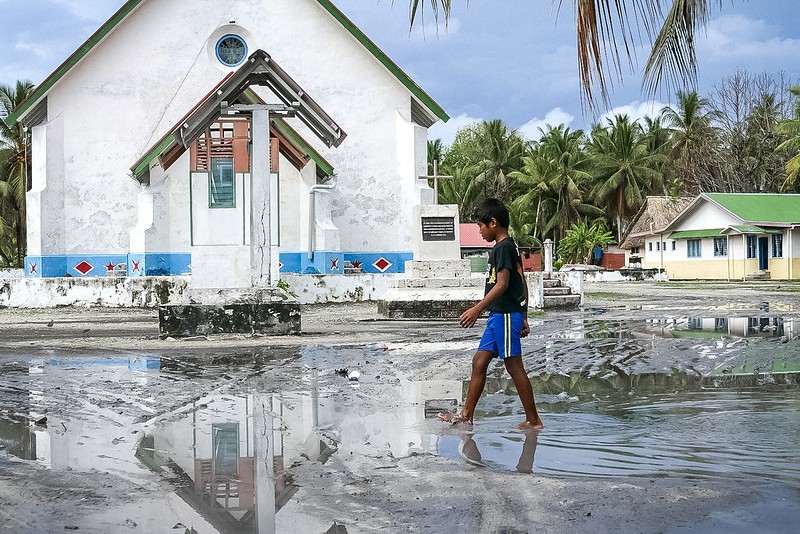
The main square of Nui Island in 2015, still under water over a month after Cyclone Pam created huge waves. Photo credit: Silke von Brockhausen/UNDP/Creative Commons via Flickr

As UK faith leaders call for an environment focused economic recovery post Covid-19, there have been great strides in faith-based climate activism. Yet Christians are often perceived as an obstacle to climate action with climate denial or apathy frequently attributed to religious communities. Within the Church, questions persist. By reflecting on my personal journey and addressing common scepticisms I argue that Christians play a key role in leading climate action.

The journey thus far

Having witnessed the Asian Tsunami in 2004 and the Bangkok floods in 2011, I have seen first-hand the devastating impacts natural disasters have on the poorest communities, especially in the global South. The strong relationship between environmental and social justice is evident, as climate change continues to impact the most vulnerable in our society.

Amidst eco-anxiety and dismal climate forecasts, faith serves as a reminder that ultimately, climate action is not about us saving the world, but fulfilling a God-given mandate of environmental stewardship. This view is shared by Christians working in conservation and climate change, from the former Chair of the IUCN to leading climate scientists.

Whilst recent actions by Christian leaders has been promising, from the Pope’s Laudato si’ to fossil fuel divestment by the Church of England, there is a long way to go. For this to ensue, key scepticisms must be addressed.

Shouldn’t poverty alleviation be the biggest global priority?

  1. Western-centric humanitarianism: Ironically, this thinking has been most prominent in post-industrial countries. Conversely, Christians in developing countries, often comprising of agrarian communities, are most attune to the dependence on nature for human flourishing. To ensure a sustainable future for subsequent generations, climate action and poverty alleviation must go hand-in-hand.
  2. Delinking of creation from salvation: God’s redemptive work has been the motivator behind Christian humanitarianism. But one of the biggest danger in churches today is overlooking His creation. It is important to remember that the ultimate act of redemption was motivated by God’s love for the world, or the entire cosmos, as argued by Peter Harris, cofounder of ARocha.
  3. A myopic view of climate action: The urgency of climate action is often lost in discussions around mitigation technologies as climate adaptation policies lag behind. Yet not only is climate change disproportionately affecting developing countries today, its worst effects are endured by the poor, women, children and ethnic minorities.
  4. Biblical commitment towards creation: Former Archbishop of Canterbury Rev Rowan Williams calls for a Jubilee year as we seek an end to social and environmental oppression. There are stark parallels between the Jubilee 2000 campaign, recent calls for debt forgiveness and the need for greater climate adaptation financing in developing countries.

Isn’t the world going to end anyway?

  1. Creation care and eschatology: There are numerous theological arguments presenting a comprehensive case for creation care and its alignment with eschatology, or the end of times. This presents not only an intergenerational vision, but an eternal vision for the world. A compelling argument for climate action, regardless of the outcome, comes from God’s ongoing work in reconciling all things on earth and heaven (Colossians 1:15-20).
  2. An eternal home: The promise that one day the earth will be renewed, reinvigorates the call to not only love our neighbours but love the eternal home in which we will dwell. If anything, the promise of ultimate restoration should make Christians the strongest proponents of climate action!

Are climate activists trying to play God?

  1. Stewardship v Sovereignty: Climate solutions are often deemed to usurp God’s power, particularly ideas like geo-engineering. Whilst criticism is healthy, and more rigorous research is required, this must be separated from overarching dismissals. Human environmental stewardship is different from divine sovereignty. Fighting for climate justice is out of reverence for the Creator and His world as opposed to insolence against His will.
  2. Climate change as a consequence of sin:  A relationship with God helps unearth the root cause of the climate crisis – a crisis of greed and overconsumption within our hearts. From this perspective, our current lifestyles, sustained by lordship over natural resources, may themselves be regarded as an attempt at playing God.
  3. Beyond climate activism: Climate action as embraced by today’s youth, calls for an attempt to live in harmony with our Creator and His world. This change in mindset means everyone has a role to play. The neighbourly love that is the foundation of faith needs to be at the centre of climate solutions.

With 84% of the world’s population identifying with a religious group, Christians must be onboard to spearhead a 1.5 °C world. In a world where religion is often the cause rather than the solution to problems, faith communities can be catalysts for change.

About the author

A person standing in front of a mountain

Description automatically generated
Shilpita Mathews is a Research Assistant at the Grantham Research Institute on Climate Change and the Environment and is currently completing a MSc in Environmental Economics and Climate Change at the London School of Economics. She also writes as a Climate Correspondent for Youth Ki Awaaz, an Indian youth media platform and serves in the student ministry of her home church, All Souls Langham Place in London.

Book Review: Climate Crisis: The challenge to the church

Posted in: Blog

Kevin Shang reviews Climate Crisis: The challenge to the church for Operation Noah.

Climate Crisis: the challenge to the church, a new book by David Rhodes, the Anglican priest and former journalist, provides a clear and powerful argument that the Church has buried the real Jesus under centuries of hierarchical structures and protective dogmas. The Church could make a crucial difference in fighting against climate change, but the first step is to rediscover the real Jesus of the Gospels and rethink the Church’s attitude towards the world. 

David argues that centuries of dogma and tradition in the Church has separated most of us from the true meaning of Jesus’life and teachings. This hinders us in knowing the real Jesus. An emphasis on sin and personal salvation in the institutional Church has stolen our attention from ‘love your neighbour’, the great commandment of Jesus. Our world contains myriad examples of groups who only love those within their ‘tribe’, including the Church. By contrast, when we love across all lines of race, class, wealth, social class, gender and nationality through our actions, we reflect something from beyond this world – God’s unconditional love. Responding to climate change is a great way for us to learn to love our neighbours and the planet.  

This book is easy to read, but not comfortable to read. It encourages us to get out of our spiritual comfort zone and re-examine our understanding of Jesus. In 1 John 3:18 we read, ‘Little children, let us not love in word or talk but in deed and in truth’ (NIV). Personal salvation and dealing with sin are important, but an emphasis on these issues can leave us satisfied with staying in a self-protective bubble while remaining apathetic to the suffering of the world. 

Written with a journalist’s courage and integrity, Climate Crisis: the challenge to the church challenges us to rethink how to follow Jesus with passion in our time. It is a great book and definitely worth the time of every Christian who is concerned about climate change. 

Buy Climate Crisis: the challenge to the church

Climate Sunday: giving a voice to local churches

Posted in: Articles, Blog

We’re marking World Environment Day with the launch of Climate Sunday, an initiative organised by Churches Together in Britain and Ireland with support from Operation Noah and other charities including CAFOD, Christian Aid, Tearfund and A Rocha UK.

We’re encouraging local churches to hold a local Climate Sunday at any time during the 12 months starting on 6 September 2020 (the first Sunday in the annual season of Creationtide). Climate Sunday will provide free resources to suit every tradition and style of worship to help each church do this. During their local Climate Sunday, we invite each church to do one or more of three things: 

  1. Climate service: Hold a climate-focused service, to explore the theological and scientific basis of creation care and action on climate, to pray, and to commit to action.
  2. Commit: Make a commitment as a local church community to taking long term action to reduce its own greenhouse gas emissions.
  3. Call: Join with other churches and wider society by adding its name to a common call for the UK government to take much bolder action on climate change in this country in advance of COP26, and to strengthen its credibility to lead the international community to adopt a step change in action at COP26. The culmination of the campaign will be a national Climate Sunday event on Sunday 5 September 2021, to share church commitments and pray for bold action and courageous leadership at COP26. 

More than 3,400* local churches are already registered with the main church greening schemes, but with the climate crisis accelerating and the UK due to host the rescheduled COP26 climate talks in November 2021 in Glasgow, we believe the time has come for all churches across the UK to pray about and act on the climate crisis.

Director of Global Advocacy at Tearfund, Dr Ruth Valerio, author of Saying Yes to Life: The Archbishop of Canterbury’s 2020 Lent Book, said: ‘The current crisis has changed the way we see the world. It has reminded us of the fragility of life, exposed the gap between rich and poor, and revealed the damage we’ve done to the wider creation. But it has also helped us love our neighbours and brought communities together. Climate Sunday is a great opportunity to respond to these societal shifts; to pause and reimagine what life could be like; to commit to living differently ourselves and to call on the UK government to rebuild our economy in a way that tackles the climate emergency and builds a better world for everyone.’

Chief Executive of A Rocha UK, Andy Atkins, and chair of the coalition, said: ‘Our vision is to leave a lasting legacy of thousands of UK churches better equipped to address this critical issue as part of their normal discipleship and mission; and to make a very significant contribution to civil society efforts to secure adequate national and international action at the COP26 conference.’

Register for Climate Sunday 

Read a blog about Climate Sunday by Andy Atkins, CEO of A Rocha UK and Chair of the Climate Sunday Steering Group.

* As of 31 May 2020, more than 3,400 of the UK’s 50,000 churches were members of one of the following schemes: Eco Church (England and Wales) 2,800; Eco Congregation Scotland 500 and Ireland; Live Simply (Catholic Churches in England and Wales) 120 parishes.

What Will It Take to Cool the Planet?

Posted in: Blog

Bill McKibben. This article originally appeared in The New Yorker on 21 May 2020. It is reproduced here with permission.

This week’s newsletter is a little different, in that I mainly want to encourage you to watch a video and then play with a Web site. Both come from the remarkable people at Climate Interactive, a project that grew out of M.I.T.’s Sloan School of Management. I’ve admired the group’s co-directors, Elizabeth Sawin and Andrew Jones, for many years, and watched their En-roads simulator grow from fairly crude beginnings into a truly sophisticated and useful model. It allows you to change different variables to see what it would take to reduce greenhouse-gas emissions enough to get us off our current impossible track (screeching toward a world something like four degrees Celsius hotter) and onto the merely miserable heading of 1.5 to two degrees Celsius envisioned in the Paris climate accords.

I pointed out last week that the covid-19 pandemic has taught us something interesting: even locking down most of the planet didn’t cut emissions as much as we might have thought. (By early April, daily CO2 emissions decreased by seventeen per cent.) This suggests that a great percentage of the trouble is hardwired into our systems, and not solely a function of our habits and choices. Indeed, the simulator shows that, if you reduce the growth of both populations and economies to the lowest level the programmers considered possible, the planet still warms almost 3.5 degrees Celsius.

But now reset the variables and go into the submenus for coal, gas, and oil, and perform a little experiment: stop building any new infrastructure for these fossil fuels beginning in 2025 and, all of a sudden, you’re at a world that warms only 2.8 degrees Celsius by 2100. That’s why it is such good news, for instance, that New York State last week quashed plans for the Williams natural-gas pipeline across the New York City harbor: if you keep building stuff like this now, it locks in emissions for decades to come, busting our carbon budget. It’s why the climate movement has fought so hard against pipelines and fracking wells and L.N.G. terminals: with ever-cheaper renewable power, when you manage to stop such projects, sun and wind have a chance at filling the vacuum.

And, once you’ve made this basic course change, you can go back to work on other steps that the simulator can model. Stipulate an all-out effort at making buildings and transport more efficient, and cut way back on deforestation—and now you’re at about 2.5 degrees. Figure out some ways to “highly reduce” methane emissions from oil and gas wells, cows, and other sources, and suddenly you’re nearing the two-degree mark.

None of these things are easy, of course. In fact, all of them are very hard. But stopping new infrastructure is possible—it’s basically a battle with the fossil-fuel industry, which, as I’ve been pointing out, is losing financial muscle with each passing week. Last week, according to the Financial Times, in a fascinating interview with Bernard Looney, the C.E.O. of BP, “Looney noted that as crude prices have plunged, renewable energy projects had been able to attract funding, suggesting the pandemic has weakened the investment case for oil. ‘It’s the model that is increasingly respected and admired by investors as being resilient and having a different risk profile,’ he said.”

Working together for a just and green recovery

Posted in: Articles, Blog

At Operation Noah we believe in working alongside others to achieve a better world. In the past month we’ve been co-signatories on a number of letters calling for a just and green recovery from COVID-19.

  • RSPB and the Green Alliance organised an open letter on a green recovery to the Prime Minister. Amongst other things, the letter called on the Prime Minister to create a more resilient economy that contributes to a climate-safe future and to build global ambition on tackling the climate crisis and restoring nature by bringing global leaders together in the run-up to COP26 in Glasgow in 2021. Read the letter.
  • Biofuelwatch organised a letter responding to a consultation on the future of biomass subsidies. Biofuelwatch are calling for an end to subsidies for high carbon biomass power in the UK. Operation Noah supporters are welcome to participate in this consultation too, although you’ll need to be quick as it closes on 29th May. More information.
  • We co-signed a letter to First Minister in Scotland, calling for the country to lead on a radical response to the double crises of climate change and Coronavirus. This letter was organised by Friends of the Earth Scotland.
  • We co-signed a statement stating that the phase out of fossil fuel production is a key pillar for a Just Recovery. The statement was organised by Global Gas and Oil Network.

Registered charity number 1138101