Steph Lake explains the Climate and Ecological Emergency Bill.
The Climate and Ecological Emergency (CEE) Bill has been written by an alliance of scientists, lawyers, academics and activists, orchestrated by the CEE Alliance, in an attempt to push the government to ACT and ACT NOW on the climate crisis!
This new bill, which at the time of
writing has the cross-party support of 84 MP’s and has been tabled in the
Commons, seeks to ensure that the government and local authorities aren’t just
making hollow environmental pledges, but that they have a comprehensive,
resourced and urgent plan.
Its aim, according to Kumi Naidoo, former International Executive Director of Greenpeace International and Secretary General of Amnesty International, is simple, to outline “the path needed to avoid the catastrophe outlined by the United Nations… it is farsighted, aiming to protect those at risk now and in the future.” He believes that, ‘the urgency and scale of the response required to tackle the emergency facing life on Earth is in this bill.’
The bill is continuing to gather support from a broad range of campaign groups,
businesses, charities and individuals, with Operation Noah adding its name to
the list.
What will the CEE Bill
do?
The Bill will set an emergency path for
the UK to follow and takes a holistic approach to tackling both the climate
emergency and the ecological emergency.
It will
force us to account for our entire carbon footprint as a country. This will
include international aviation and shipping emissions as well as emissions from
all our goods and services, whether they are produced in the UK or produced
abroad and imported into the UK.
It asks us
not to rely on technology to save the day by circumscribing reliance on
speculative future carbon capture technologies.
The Bill
also ask us to actively protect and restore nature and biodiversity, including along
domestic and international supply chains. It has a focus on biodiversity, soils
and natural carbon sinks.
It will
see the creation of a Citizen’s Assembly ‘with bite’ that allows ordinary people
to have a real say on the way forward.
Leadership at COP26
In the lead up to COP 26, which will be
hosted in Glasgow in November 2021, it is essential that the UK government takes
a lead on the climate crisis. The UK must take responsibility for its
contribution to the climate crisis, as we are disproportionately responsible
for both historic and existing emissions and, therefore, need to move furthest
and fastest in our response. The CEE bill will allow us to do this.
Do we need another
climate bill?
At a recent CEE Alliance webinar,
Caroline Lucas Green MP for Brighton and Hove alerted us to the fact that
“every warning light on the dashboard is flashing red” when it comes to the
climate crisis. The CEE Bill is needed to build on the success of the Climate
Change Act 2008.
She emphasised that the existing \Climate Change Act is not ambitious or comprehensive enough for the scale of action needed. The science has moved on and our position concerning tipping points, global emissions and rising temperatures is so much worse than it was when the CCA bill was first passed over a decade ago.
The UK government has
pledged to be carbon zero by 2050, but 2050 is too late. According to the Intergovernmental
Panel on Climate Change (IPCC), if we halve emissions global by 2030 and reach
net zero by 2050 we have a 50:50 chance of limiting warming to 1.5°. This is no
better than flipping a coin!
What can you do?
The CEE bill needs to be made law, only
then can its brilliant pledges be put into action!
Join the campaign by signing up at the CEE website where you can find out more about how you can lobby
your MP and local authority.
This month we have news of a record number of faith institutions divesting from fossil fuels, as well as new Climate Sunday resources and a climate-focused Advent resource. We’ve also appeared in the media a number of times during November.
To receive future newsletters straight to your inbox, please use the email sign-up form on the left or click here.
In October 2020 Rev Helen Burnett held two Climate Sunday services at St Peter and St Paul’s Chaldon, in the Diocese of Southwark where she is Vicar. She has kindly shard her service sheets, prayers and sermons for anyone who finds them of use in planning their own Climate Sunday service.
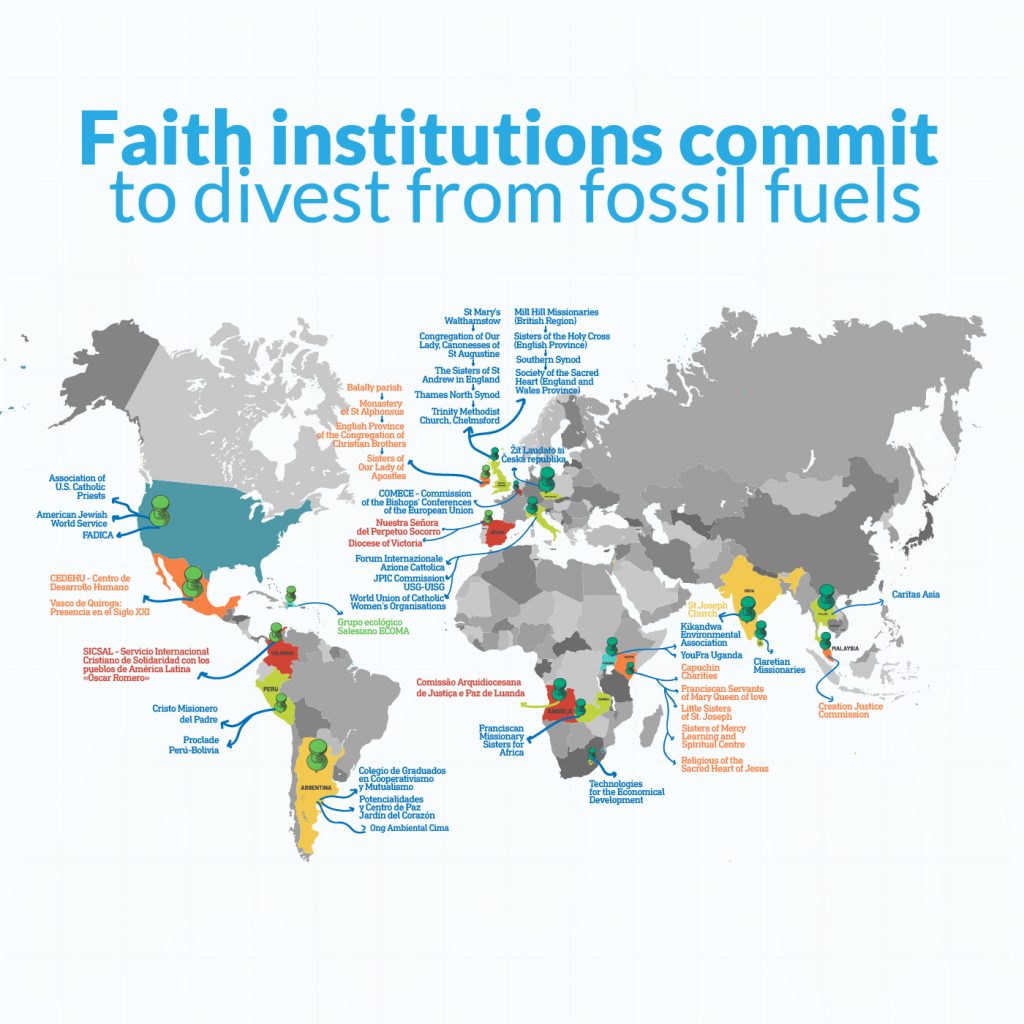
Today, 47 faith institutions from 21 countries, including nine institutions from the UK, announce their divestment from fossil fuels as a practical response to the climate emergency.
Participating institutions include five Catholic religious orders in the UK, two United Reformed Church Synods, UK-based local Anglican and Methodist churches, the Commission of the Bishops’ Conferences of the European Union (Catholic) and American Jewish World Service. The full list of participating institutions is here.
The announcement coincides with the fifth anniversary of the Paris Agreement on Climate Change. Faith leaders’ action puts pressure on government leaders, and their commitment to clean energy stands in stark contrast with many governments’ failure to deliver ambitious energy strategies.
The UK government faces increasing pressure to demonstrate global leadership on the climate crisis ahead of the UN climate talks (COP26) taking place in Glasgow in November 2021. Earlier this month, 70 organisations launched The Climate Coalition’s 10 Point Plan for a Green, Healthy and Fair Recovery. This includes a call for the UK government to end all public support for fossil fuels overseas and support countries to leapfrog to renewable and efficient energy.
Recently, in preparation for the G20 meeting that begins on 21 November, environment ministers released a statement that was widely seen as rubber-stamping fossil fuel bailouts and removed a long-standing G20 call for the end to fossil fuel subsidies.
With renewables now growing at a faster pace than fossil fuels, institutional investors are increasingly moving toward sustainable investments in the clean energy economy. Faith investors are an important part of this movement, constituting the single-largest source of divestment in the world, making up one-third of all commitments.
Pressure from faith investors and others has exposed the inherent weakness of the fossil fuel industry, with Royal Dutch Shell now citing divestment as a material risk to its business.
This week, from 19-21 November, Pope Francis has convened the ‘Economy of Francesco’, an online conference involving more than 1,000 young adults, which will explore innovative ways of shaping a sustainable economy. This conference builds on an announcement in June, when the Vatican recommended in its first-ever operational guidelines on ecology that all Catholic organisations divest from fossil fuels.
Today’s divestment announcement means that more than 400 religious institutions have now committed to divest.
Statements from leaders:
Inger Andersen, Under-Secretary-General of the United Nations and Executive Director of the UN Environment Programme, said: ‘The economic power of faiths, turned to responsible investments and the green economy, can be a major driver of positive change, and an inspiration to others, as we rebuild better.’
James Buchanan, Bright Now Campaign Manager at Operation Noah, said: ‘It is hugely encouraging that so many faith institutions have stopped investing in the fossil fuel industry. Churches need to divest from fossil fuel companies as a practical response to the climate emergency ahead of COP26 next year. The UK government urgently needs to end all public support for fossil fuels at home and overseas.’
The United Reformed Church Southern Synod has transferred its reserves into a new fund that excludes the oil, gas, and coal industries. Revd Bridget Banks, Moderator of United Reformed Church Southern Synod, said: ‘We are pleased that we have been able to achieve this during the COVID lockdown. It’s an issue that we have been wrestling with for several years. It is good that we have now brought our investments into line with our commitment to reduce the carbon footprint of the Synod. Many of our local congregations are also exploring how to line up the ways they do things with their belief that this world is God’s world and God calls us to take care of it.’
Fr Dermot Byrne MHM, Regional Representative for the Mill Hill Missionaries (British Region), said: ‘Our members have always worked among the poorest and most disadvantaged in Africa, Asia and South America, and the pursuit of social equality and justice has always been a serious priority for us. Concern for what Pope Francis reminds us is ‘our common home’ has to be part of that pursuit. There can seem to be little that we can do to make an impact, but divestment from fossil fuels is a practical choice that is open to us all and may have far-reaching results. Consequently, we feel that such divestment is in line with Catholic social teaching and the spirit of the present age, and we are happy that we, as a Region, are able to make this small contribution.’
Revd Vanessa Conant, Rector, St Mary’s Walthamstow and the Parish of Walthamstow (Photo credit: Cameron Conant)
Revd Vanessa Conant, Rector of St Mary’s Walthamstow and the Parish of Walthamstow, said: ‘The climate crisis is the most critical issue facing our planet and, as Christians, we must act. People in my parish experience the impacts of this crisis every day through ill health related to air pollution and are worried about what we will leave future generations. It’s no longer acceptable to fund fossil fuels or assume these businesses will regulate themselves. We must divest, and must use our power to hasten the green energy revolution we need.’
Robert Bank, President and CEO of American Jewish World Service, said, ‘We decided to divest from fossil fuels earlier this year to align fully how we invest our funds with our global grantmaking to combat climate change and secure climate justice for the most vulnerable people in the world, ensuring that we live our Jewish values and take up our enduring commitment to repair our broken world.’
The full list of participating institutions is here.
1. Operation Noah is a Christian charity working with the Church to inspire action on climate change. It works with all Christian denominations. operationnoah.org
4. An infographic map of committed institutions is here and here.
5. Global Divestment Announcement Statement:
The World Council of Churches, the Global Catholic Climate Movement, Operation Noah, Green Anglicans and GreenFaith invite faith institutions from around the world to join a global divestment announcement on 16 November 2020.
The global divestment announcement, which will coincide with the fifth anniversary of the Paris Agreement, offers an opportunity to faith organisations to highlight the urgent need to divest from fossil fuels and invest in clean alternatives.
The announcement will send a strong message to world leaders meeting at the G20 summit in November about the need for a green and just recovery from Covid-19. It will take place the week before the Economy of Francesco event, at which Pope Francis will give an online address to young economists and entrepreneurs from around the world.
Divestment from fossil fuel holdings is a powerful act of faith that hundreds of religious institutions around the world have taken to respond to the climate emergency. It represents the shifting of investments out of an industry that is a primary cause of the climate crisis. Furthermore, an increasing number of values-driven investors are investing in solutions to the crisis, and are financing enterprises and initiatives providing access to clean, affordable energy, including zero-carbon energy solutions for the 850 million people without access to electricity.
Any groups interested in joining the announcement will confirm (i) that they have divested from fossil fuel investments; or (ii) that they will divest from any investments in fossil fuels as soon as possible, and within five years at the latest; or (iii) that they do not hold any fossil fuel investments and will not invest in fossil fuels in the future.
In these strange and difficult times when so much feels tenuous, from our employment to our health, Cameron Conant keeps returning to this sentence from Pope Francis, ‘Realities are more important than ideas.’ (Evangelii Gaudium (Joy of the Gospel) 231)
Cameron is one of the co-leaders of the Citizens UK ‘Just Transition’ campaign
I puzzled over these words for several months
before realising that Pope Francis was trying to help me (and all of us)
understand that what often prevents us from acting on injustice, including the
injustice of climate change, is our allegiance to certain ideas over and above
our commitment to understanding the experiences of the people in our
neighbourhood or of those around the world.
When we idolise an economic philosophy, a
particular way of reading the Bible, or a political ideology, we risk missing
out on what’s happening to people down the road, across town or in another
country.
For those of us trying to be Christians in these
unsettling times, I’m convinced we must avoid the temptation of getting lost in
a world of ideas, oblivious to the lived experiences of our neighbours –
something Pope Francis suggests leads to ‘a life-less and unfruitful
self-centeredness’ (Evangelii Gaudium, 233).
Many of us will know from Scripture, if not from
our own experiences, that a lived-out faith is the only faith there is
(James 2:20); indeed, salvation is not some invisible spiritual transaction as
much as something that happens when the defrauded get paid back (Luke 19:8-9),
or when the poor, imprisoned and marginalised get fed, clothed, visited and
welcomed (Matthew 25:34).
However, just like faith can become ‘lifeless’ when
it is disconnected from the experiences of others, the climate crisis can also
become just another ‘idea’ that we engage with rather than something that
actually happens to real people with names and stories – people who we are
called to walk alongside.
Just Transitions
As an Operation Noah Board Member and as one of the
co-leaders of the Citizens UK ‘Just Transition’ campaign, people’s personal
stories help inform and shape the work I do. In fact, over these past three
months, my church has been part of a listening campaign that has stretched
across the whole of London – 400 people from 20 different institutions talking
about how London’s polluting energy, housing, economic and transport systems
impact them and their families.
In listening to people, we have heard how expensive
energy bills and poor insulation can make home a difficult place to be (as well
as being major source of carbon emissions), the ways in which air pollution
negatively impacts health, and how insecure work is a source of stress for
families and young people.
We’ve spoken to a diverse range of Londoners –
Christians, Jews, Muslims, university students, retirees and even children. Like
Noah, just eight years old, who lives in East London, was born with a lung
condition and has asthma. Noah sometimes stays awake all night, coughing,
because of the air pollution outside his house, and occasionally misses school
as a result. When we talked with Noah and his parents, Noah asked us, ‘Is clean
air too much to ask for?’
We also spoke with Bel who lives in Lambeth, is in
his early 20s, and is currently looking for work, but would ‘love to be part of
the work force that re-builds the UK’ as part of the kind of post-pandemic,
clean energy revolution we need.
These and many other stories are shaping the ‘Just
Transition’ policies that our Citizens UK alliance is now developing with the
public policy think tank IPPR. Green policies we will put to the candidates for
Mayor of London at our Mayoral Assembly in 2021, which we will hold either in
person or online.
We’re placing people’s experiences at the heart of
London’s response to the climate crisis by developing policies that prioritise
poor and low-income communities and we’re involving these same communities in
the process.
Being part of this London-wide listening campaign
has reminded me of how important it is for people to share their experiences. It
has also reminded me that the Gospel is not merely a future salvation event,
but a present one.
Ideas are important and necessary, but as Pope Francis reminds us, and as my fellow Londoners’ experiences confirm, realities are more important than ideas.
Cameron Conant is a writer and Operation Noah board member. Learn more about the Just Transition campaign.
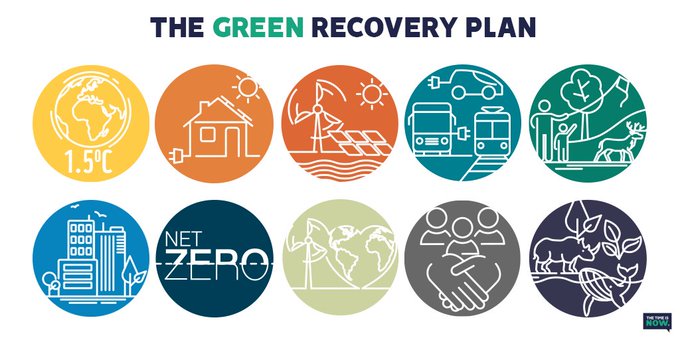
Operation Noah is one of 70 organisations who have, today, launched
a 10 -point plan designed to get the UK on track to net-zero emissions whilst
also showing global leadership ahead of hosting the United National climate
summit, also known as COP26, this time next year.
Last month the Prime Minister confirmed that the government will take action to achieve 40GW of offshore wind by 2030, more than enough to power every home in the UK. This was set out as the first point of a 10-point plan for a ‘green industrial revolution’. The full plan will be laid out before the end of this year. In the meantime, a number of NGOs working on climate change has set out our own 10-Point Plan.
The ten points include the UK taking on its fair share of effort to keep global temperatures rises to 1.5°C above pre-industrial levels, investing in domestic energy efficiency and heat pumps which will help us move away from using gas to heat homes, fully decarbonising our power system and ambitious targets for nature restoration. All ten points are set out in this document.
The time to act is now
Actions taken now
by governments to respond to the current health crisis and rebuild our economy
will have an impact for generations to come. Decisions taken today will
determine whether we succeed in our goal to protect the people, places and life
we love from the climate crisis. We can limit global temperature rise to 1.5°C,
halt and reverse the decline of nature and eradicate poverty, or we can lock in
pollution and inequality for generations.
Next year the eyes
of the world will be on the UK as it hosts the UN Climate Summit, COP26. This
is an opportunity to deliver a strong global lead on climate action. The best
way to show this leadership is to put resilience at the heart of our economic
recovery by accelerating the transition to net-zero, restoring nature and
supporting the most vulnerable at home and overseas.
The 10-point plan is part of the Climate Coalition’s
campaign for the government to deliver an economic recovery that sets us on a
path to a cleaner, greener world that works for everyone.