Back in December 2020 we announced Operation Noah’s support for the Climate and Ecological Emergency Bill (CEE Bill). We are one of more than 60 organisations who are members of the CEE Bill Alliance. We now need your help to keep it high on the political agenda.
The Climate and Ecological Emergency Bill
In a nutshell, the Climate and Ecological Emergency Bill calls for the UK to make and enact a serious plan to deal with the climate emergency.
“This Bill outlines the path needed to avoid the catastrophe outlined by the United Nations… it is farsighted aiming to protect those at risk now and in the future.” – Kumi Naidoo, former International Executive Director of Greenpeace International and Secretary General of Amnesty International,
It has the potential to become the most significant move forward on the climate emergency since the Climate Change Act 2008. It is a Private Members’ Bill, and taking it through parliament will be a hard-fought process but it has been done before with major climate legislation. It is an alliance bill that has been written by scientists, lawyers and activists and it is gathering support from a broad range of campaign groups, businesses, charities and individuals.
Create a Twitter storm and drop a banner
Recently, a second hearing of the bill was postponed for the second time when Friday sittings of Parliament were cancelled. With this in mind, the CEE Bill Alliance is calling for a day of action on 26th March. We’re encourage Operation Noah supporters to get involved by doing two things:
Help create a Twitter storm – a sudden increase of posts on Twitter about the Bill. Record a message and tweet it to your MP asking them to back the CEE Bill (#CEEBill).
Drop a banner in your local area. Many Church buildings would make good locations for a banner drop.
Operation Noah board member, Rachie Ross, recently spoke to church leaders in her local area about how they could best tackle the climate crisis. Watch her talk here.
Operation Noah has board members available to talk to your church or church leaders. Get in touch to find out more.
Operation Noah is excited to see the launch of a new Climate Emergency Toolkit for churches and Christian organistations from Tearfund.
As the climate crisis accelerates, millions of lives are at risk. We’re aware of this, but sometimes it can be hard to know what to do next to tackle the climate crisis. The new Climate Emergency Toolkit from Tearfund encourages churches to declare a climate emergency and maximise their impact by influencing others around them to take the climate emergency seriously.
The toolkit provides a roadmap for action and brings together lots of brilliant resources from a range of organisations, including Operation Noah, organising them into a clear, manageable journey that any church can take. What better way to kickstart your creation care in 2021?
Catherine DeSouza, Pastor at Cardiff City Church, speaking about the toolkit said: ‘Climate change wasn’t high up on my agenda…What kicked me into action was recognising that I have a role, we have a role,the church has a role to play in this and we can do something about it.’
Dr Tim Gordon, Marine biologist and Honorary Research Fellow at the University of Exeter said: ‘Climate change directly threatens the lives of millions of people. If your church is serious about loving people, it has to be serious about climate change.’
In November 2021, world leaders will gather in Glasgow for COP26, critical talks on how to address the climate emergency. Each church that declares or recognises the emergency shines a spotlight on the crisis, underlining its seriousness and the need for world leaders to agree to significant progress during the talks. Together, we can be a prophetic voice for change.
There has been growing support in the Methodist Church for divestment from fossil fuels. In June 2020, 260 Methodists (including 114 ministers) signed a letter calling for the Central Finance Board of the Methodist Church to fully divest. The Methodist Council passed a resolution on divestment in October 2020. Several Methodist churches have already announced their decision to divest from fossil fuels.
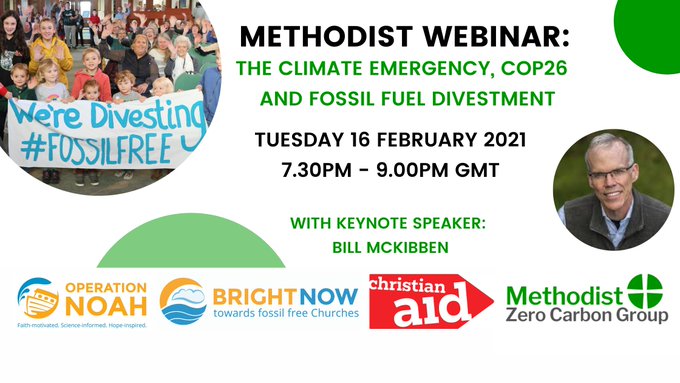
Join this interactive webinar to hear why divestment is such an important response to the climate crisis with Bill McKibben, who started the global fossil fuel divestment movement, and Mark Campanale, whose groundbreaking research with Carbon Tracker has highlighted the risks of continued investment in fossil fuels. The webinar will be an opportunity to hear from Methodist leaders who are campaigning for divestment and find out how you can get involved.
We are delighted to welcome the following speakers:
Keynote speaker: Bill McKibben, author, environmentalist, Methodist and co-founder of 350.org: The moral imperative to divest from fossil fuels, the global divestment movement and why 2021 is a crucial year for tackling the climate crisis
Mark Campanale, founder of the Carbon Tracker Initiative: The financial risk of fossil fuel investments
James Buchanan, Bright Now Campaign Manager at Operation Noah: Key findings of Bright Now report: Church investments in major oil companies: Paris compliant or Paris defiant?
Martha Rand, Vice Chair of the Methodist Zero Carbon Group: Responding to the climate emergency for the new generation of Methodists
Sheridan Pengelly, Vice Chair of the Methodist Zero Carbon Group: The experience of a local church divesting from fossil fuels
Revd John Howard, former Chair of JACEI (the Methodist Church’s ethical investment advisory group) will join the speaker panel for Q&A.
The webinar will be chaired by Michael Pryke, Chair of the Methodist Zero Carbon Group and former Methodist Youth President.
The webinar will also offer an opportunity to find out more about how your church, Circuit or District can join the next global divestment announcement for faith institutions in spring 2021. The Methodist Zero Carbon Group will share a new resource on divestment as well as introducing other areas they will be working on ahead of the upcoming UN climate talks, COP26, in Glasgow in November 2021.
The webinar is sponsored by Operation Noah, Christian Aid and the Methodist Zero Carbon Group.
Revd Elaine Garman speaks during the online Synod of the Scottish Episcopal Church about the need to commit to net zero carbon emissions by 2030.
Christian environmental and development charities Christian Aid, Eco-Congregation Scotland and Operation Noah today joyfully welcome the decision of the Scottish Episcopal Church, at their General Synod, to set a 2030 net zero carbon emissions target.
The motion was proposed by Revd Elaine Garman, Acting Convenerof the Church in Society Committee for the Scottish Episcopal Church. Speaking ahead of the motion being carried, she said, ‘We are in a climate emergency… We all must act and act now. As a Church we must lead… Our motion today is designed to enable the Scottish Episcopal Church…in reducing our negative impact on our climate… We can be part of Scotland’s preparations for the COP26 climate summit next year.’
The motion, passed by General Synod, reads: ‘That this Synod, expressing the need for urgent action in relation to the global climate emergency, call on the Church in Society Committee, working in conjunction with other appropriate bodies, to bring forward a programme of actions to General Synod 2021 to resource the Scottish Episcopal Church in working towards achieving net zero carbon emissions by 2030.’
The decision to set a 2030 net zero target is especially significant as Glasgow prepares to host the UN climate talks, COP26, in November 2021.
The Provost of St Mary’s Episcopal Cathedral Edinburgh, The Very Revd John Conway, welcomed the motion: ‘This is an important first step for the Scottish Episcopal Church, showing our commitment to action in the face of the depth of the climate crisis. Responding to the climate emergency is the most urgent task facing us all, requiring all the spiritual and intellectual resources available. To speak with any authority about that spiritual task of living more simply, however, requires us to put our own house in order, and this motion sets us on that road. I look forward to the resources offered to help us all move to being carbon neutral in 10 years time.’
In June 2019, the Scottish Episcopal Church General Synod voted to change its ethical investment policy following a motion proposed by the Revd Diana Hall, Rector of St Anne’s, Dunbar. The motion stated that ‘the ethical investment policy be updated to reflect the moral imperative to divest fully from fossil fuels’.
Since then, an Ethical Investment Advisory Group (EIAG) has been established. which gave its first report to General Synod today. The report stated that the Church has sold its direct investments in fossil fuel companies, but continues to invest in fossil fuels indirectly through its pooled funds.
At General Synod, there were calls for the Scottish Episcopal Church to publicly announce its commitment to divest from fossil fuels and to complete the divestment process as soon as possible. In his speech to the General Synod, The Very Revd John Conway welcomed the work done to date by the Ethical Investment Advisory Group (EIAG) and asked the Church’s College of Bishops to sign the Scottish Churches COP26 Pledge: Divestment and the Just and Green Recovery, which was recently launched by Eco-congregation Scotland and other partners.
The decision of the Scottish Episcopal Church to reach net zero emissions in the next decade follows the Church of England decision to set a 2030 net zero target earlier this year.
At the Church of Scotland 2020 General Assembly in October, the Church’s Faith Impact Forum brought a proposal to the General Assembly ‘for the Church to transition both locally and nationally to net zero carbon emissions by 2030’. Many local authorities have also made this pledge, including the City Councils of Edinburgh and Glasgow.
Sally Foster-Fulton, Head of Christian Aid Scotland, said: ‘Only this week the Secretary General of the United Nations told the world we have a climate emergency which is impacting most heavily on the world’s most vulnerable people. We know all too well here at Christian Aid that those who have done the least to cause the problem suffer the most. And so it’s really encouraging that today the Scottish Episcopal Church has decided to commit to net zero emissions by 2030. As 2020 draws to a close, we can look ahead to COP26 in Glasgow alongside our Church partners in Scotland, as they continue to pursue decisions that will lead to climate justice for those living on the sharp end of the climate emergency.’
Mary Sweetland, Chair of Eco-congregation Scotland, said: ‘We are really pleased to see that our supporting Churches are backing the priority to aim for net zero by 2030, which will bring changes to local congregations and their members.’
James Buchanan, Bright Now Campaign Manager at Operation Noah, said: ‘It is wonderful news that the Scottish Episcopal Church has set a target of reaching net zero emissions by 2030. In order to demonstrate leadership on the climate crisis ahead of the UN climate talks in Glasgow next year, it is vital that the Scottish Episcopal Church supports a just and green recovery from Covid-19 by completing divestment from fossil fuel companies and investing in the clean technologies of the future.’
1. Operation Noah is a Christian charity working with the Church to inspire action on climate change. It works with all Christian denominations. operationnoah.org
2. Christian Aid holds a vision of a better world, free from poverty and climate change. For over ten years, Christian Aid Scotland has been campaigning for the UK and Scottish Governments to take climate change seriously for the benefit of those who are impacted first and worst by its effects. christianaid.org.uk
3. Eco-Congregation Scotland is a movement of Scottish church congregations, of all denominations and none, committed to addressing environmental issues through their life and mission. ecocongregationscotland.org
4. The motion passed by the Scottish Episcopal Church General Synod reads as follows: ‘That this Synod, expressing the need for urgent action in relation to the global climate emergency, call on the Church in Society Committee, working in conjunction with other appropriate bodies, to bring forward a programme of actions to General Synod 2021 to resource the Scottish Episcopal Church in working towards achieving net zero carbon emissions by 2030.’
Steph Lake explains the Climate and Ecological Emergency Bill.
The Climate and Ecological Emergency (CEE) Bill has been written by an alliance of scientists, lawyers, academics and activists, orchestrated by the CEE Alliance, in an attempt to push the government to ACT and ACT NOW on the climate crisis!
This new bill, which at the time of
writing has the cross-party support of 84 MP’s and has been tabled in the
Commons, seeks to ensure that the government and local authorities aren’t just
making hollow environmental pledges, but that they have a comprehensive,
resourced and urgent plan.
Its aim, according to Kumi Naidoo, former International Executive Director of Greenpeace International and Secretary General of Amnesty International, is simple, to outline “the path needed to avoid the catastrophe outlined by the United Nations… it is farsighted, aiming to protect those at risk now and in the future.” He believes that, ‘the urgency and scale of the response required to tackle the emergency facing life on Earth is in this bill.’
The bill is continuing to gather support from a broad range of campaign groups,
businesses, charities and individuals, with Operation Noah adding its name to
the list.
What will the CEE Bill
do?
The Bill will set an emergency path for
the UK to follow and takes a holistic approach to tackling both the climate
emergency and the ecological emergency.
It will
force us to account for our entire carbon footprint as a country. This will
include international aviation and shipping emissions as well as emissions from
all our goods and services, whether they are produced in the UK or produced
abroad and imported into the UK.
It asks us
not to rely on technology to save the day by circumscribing reliance on
speculative future carbon capture technologies.
The Bill
also ask us to actively protect and restore nature and biodiversity, including along
domestic and international supply chains. It has a focus on biodiversity, soils
and natural carbon sinks.
It will
see the creation of a Citizen’s Assembly ‘with bite’ that allows ordinary people
to have a real say on the way forward.
Leadership at COP26
In the lead up to COP 26, which will be
hosted in Glasgow in November 2021, it is essential that the UK government takes
a lead on the climate crisis. The UK must take responsibility for its
contribution to the climate crisis, as we are disproportionately responsible
for both historic and existing emissions and, therefore, need to move furthest
and fastest in our response. The CEE bill will allow us to do this.
Do we need another
climate bill?
At a recent CEE Alliance webinar,
Caroline Lucas Green MP for Brighton and Hove alerted us to the fact that
“every warning light on the dashboard is flashing red” when it comes to the
climate crisis. The CEE Bill is needed to build on the success of the Climate
Change Act 2008.
She emphasised that the existing \Climate Change Act is not ambitious or comprehensive enough for the scale of action needed. The science has moved on and our position concerning tipping points, global emissions and rising temperatures is so much worse than it was when the CCA bill was first passed over a decade ago.
The UK government has
pledged to be carbon zero by 2050, but 2050 is too late. According to the Intergovernmental
Panel on Climate Change (IPCC), if we halve emissions global by 2030 and reach
net zero by 2050 we have a 50:50 chance of limiting warming to 1.5°. This is no
better than flipping a coin!
What can you do?
The CEE bill needs to be made law, only
then can its brilliant pledges be put into action!
Join the campaign by signing up at the CEE website where you can find out more about how you can lobby
your MP and local authority.