News

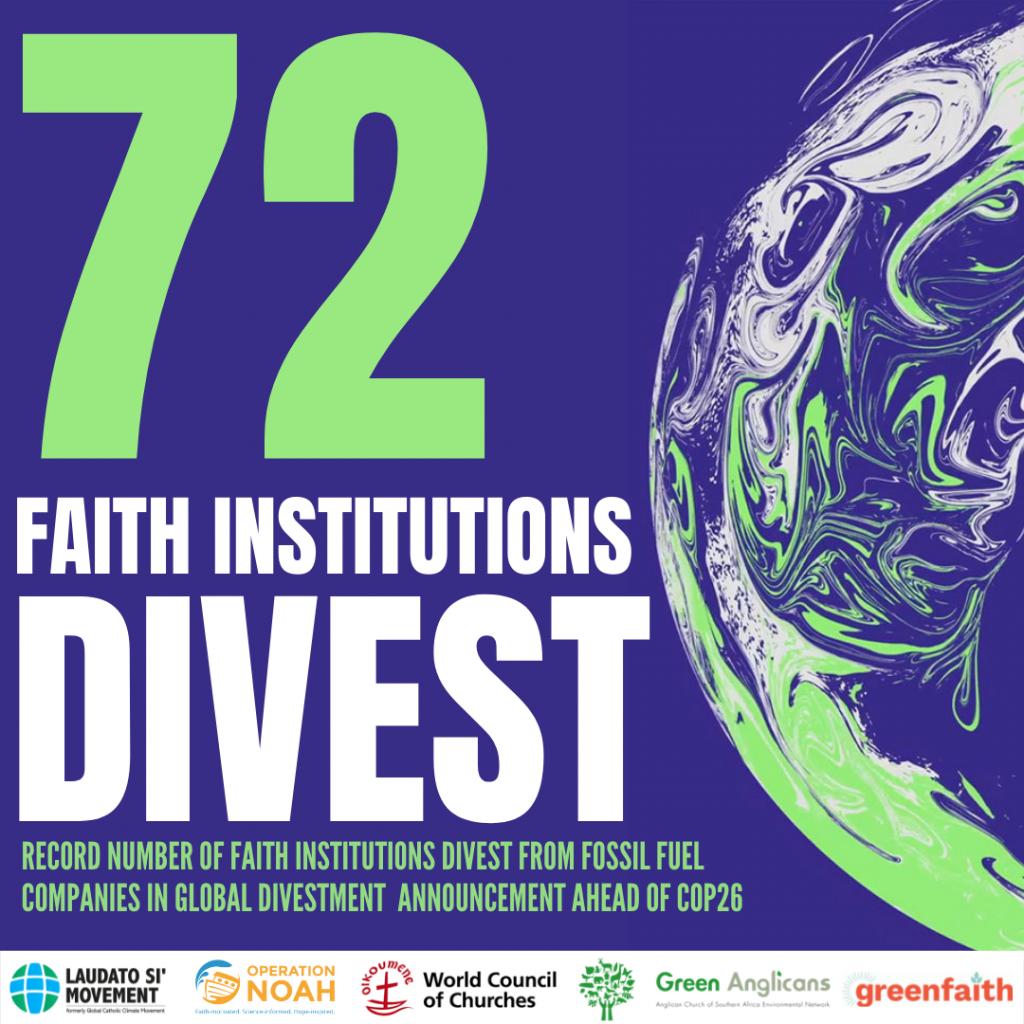
Ahead of COP26, 72 Institutions Make Largest-Ever Faith Divestment Announcement

Posted in: Blog, Featured, News

Catholic Bishops’ Conference of Scotland and UK faith groups representing nearly 2,000 local churches announce divestment before UN Climate Conference

Tuesday 26 October 2021: Today, five days before the UN climate conference, COP26, in Glasgow, and four days before the G20 Summit in Rome, 72 faith institutions, including 37 from the UK, announce their divestment from fossil fuels in the largest-ever joint divestment announcement by religious organisations.

The global divestment announcement comes from faith institutions with more than $4.2 billion of combined assets under management in Australia, Ireland, Italy, Kenya, Nepal, Peru, Ukraine, the UK, the United States and Zambia.

Participating institutions include the Catholic Bishops’ Conference of Scotland; the Central Finance Board of the Methodist Church; the Presbyterian Church of Wales; the Presbyterian Church in Ireland; 15 Catholic dioceses in the UK and Ireland, including the Archdioceses of Glasgow, St Andrews & Edinburgh, Birmingham and Southwark; the Church of England Dioceses of Truro and Sodor & Man; and the Buddhist religious movement Soka Gakkai International – UK. The UK Churches and dioceses involved in this announcement represent nearly 2,000 local churches.

It follows the recent call from Pope Francis and other faith leaders to global governments to address the ‘unprecedented ecological crisis’ ahead of COP26 and calls from an international alliance of grassroots multi-faith activists who have called for an immediate end to all fossil fuel finance. Today’s announcement shows an increasing number of Catholic institutions are responding to the recent Vatican recommendation to divest from fossil fuel companies and invest in climate solutions.

Bishop Bill Nolan, Bishop of Galloway and Lead Bishop on the Environment for the Catholic Bishops’ Conference of Scotland, said: ‘The bishops decided that disinvestment would show that the status quo is not acceptable and further, that given the harm that the production and consumption of fossil fuels is causing to the environment and to populations in low income countries, it was not right to profit from investment in these companies. Disinvestment is a sign that justice demands that we must move away from fossil fuels.’

Many UK Churches have fully divested from fossil fuel companies this year, including the Church of Scotland, the Church in Wales and the Baptist Union.

The fossil fuel divestment movement has grown exponentially in recent years. According to a new report published today, more than 1,485 institutions with combined assets of over $39 trillion have made some form of divestment commitment, up from a starting point of $50 billion in 2014. Faith institutions have been at the forefront of the global divestment movement, representing more than 35% of total commitments. Glasgow, Rio de Janeiro, Paris, Seattle and Auckland are also announcing their divestment commitments today, joining the C40 Divest / Invest Forum supporting the advancement of divestment of their city and pension funds. 

The International Energy Agency (IEA) stated in its recent Net Zero by 2050 Roadmap that there can be no new coal, oil and gas developments if the world is to limit global warming to below 1.5°C and prevent catastrophic climate impacts. As world leaders prepare to meet at COP26, the UK Government is coming under increasing pressure over plans for the Cambo oil field off the coast of Scotland, supported by oil giant Shell, which would release emissions equivalent to the annual carbon pollution from 18 coal-fired power stations.

Last month, more than 20 Southern African Anglican bishops including the Archbishop of Cape Town, the three bishops of Mozambique and the Bishop of Namibia called for an immediate halt to gas and oil exploration in Africa. They said that ‘a new era of economic colonialism by fossil fuel companies is well underway’ and that ‘Africa’s natural habitats are being destroyed at an alarming rate through the extraction of oil and gas’.

James Buchanan, Bright Now Campaign Manager at Operation Noah, said: ‘As the UK prepares to host COP26, we are delighted that 37 UK faith institutions have decided to divest from fossil fuel companies and join this record global divestment announcement. We call on the UK and global governments to end fossil fuel subsidies and bring an immediate halt to new oil and gas exploration, including the Cambo oil field.’

A full list of the 72 institutions divesting from fossil fuels and quotes from leaders can be found here.

Statements from leaders:

Archbishop Bernard Longley, Archbishop of Birmingham, said: ‘Our commitment to divestment in fossil fuels is a response both to the cry of the earth and of the poor, taking us one step further towards its consolation. We join many other faith organisations who are making the ethical choice to ‘take care not to support companies that harm human or social ecology… or environmental ecology’, as Pope Francis calls us to do in the Vatican’s manual Journeying Towards Care For Our Common Home. To see so many united in this aim gives me great hope for the future.’

David Palmer, Chief Executive Officer of the Central Finance Board of the Methodist Church, said: ‘The pace of change across the oil and gas sector has been inadequate and falls well below the targets set at COP21 in Paris. We hope that COP26 will refresh these targets and we look forward to joining other faith groups in Glasgow next month in calling for immediate action to address the climate emergency.’

Revd Evan Morgan, Moderator of the Presbyterian Church of Wales, said: ‘Our General Assembly passed a resolution to divest from fossil fuels this year as part of our new green environmental policy as a denomination. We realise time is running out and to safeguard the planet and fulfil our role as stewards of God’s creation, the Church amongst other organisations must act. The time for words, however well meaning, is over and actions now are the order of the day and to be proactive in our response to the challenges of the climate crisis.’

Rt Revd Dr David Bruce, Moderator of the Presbyterian Church in Ireland, said: ‘At its General Assembly on 5 October 2021, the Presbyterian Church in Ireland directed its trustees to employ a new strategy in relation to companies producing fossil fuels or deriving part of their turnover from their use. Specifically this will mean divesting from those companies that derive more than 10% of their turnover from oil and gas extraction and engaging with other companies which are major users of fossil fuels. We believe that our investment policies should be informed by the biblical understanding of creation that leads to a commitment to God’s world and to our global neighbours.’

Robert Harrap, General Director of Soka Gakkai International – UK, said: ‘As a Buddhist organisation based on a philosophy of respect for the dignity of life and the non-duality of the individual and the environment, it is important to us that we invest sustainably and responsibly. Our trustees have decided to divest from fossil fuels because this is a key way to protect our precious planet and the people most at risk from the climate crisis.’

Bishop Luke Pato of Namibia said: ‘We are guardians of the land for the generations to come. Namibia is the driest country south of the Sahara and our ground water is the heritage we leave for our children and grandchildren. We cannot risk drilling operations that pollute precious water sources, abuse indigneous rights and threaten the heritage site of the Okavango Delta.’

Lorna Gold, Chair of Laudato Si’ Movement, said: ‘People of faith are divesting at scale from coal, oil and gas, calling on the G20 in Rome and world leaders at COP26 to finally conclude that there is no future for fossil fuel finance. Fossil fuel divestment is a key part of ensuring a just transition for all, especially communities around the world who have done least to cause the climate crisis.’

Revd Dr Rachel Mash, Environmental Coordinator of Green Anglicans, said: ‘Faced with environmental devastation, pollution of precious water sources and abuse of land rights caused by fossil fuel companies, it is easy for those on the frontline of climate change to feel overwhelmed by the power of these corporations. When we hear that faith communities are taking their money out of these companies, it rekindles hope that we are not alone.’

Revd Fletcher Harper, Executive Director of GreenFaith, said: ‘In the midst of a climate emergency, fossil fuel divestment is a moral imperative. More and more religious groups – Muslim, Hindu, Buddhist and Jewish as well as Christian – must continue to add their names to the growing list of divestment commitments, and must also lead the way by investing in ensuring access to clean energy for absolutely everyone – particularly the 800 million people who lack electricity.’

ENDS

Contact: Cameron Conant, Operation Noah: communications@operationnoah.org

James Buchanan, Operation Noah: james.buchanan@operationnoah.org

Notes for editors:

1. Operation Noah is a Christian charity working with the Church to inspire action on climate change. It works with all Christian denominations. operationnoah.org

2. Operation Noah’s Bright Now campaign encourages UK Churches to divest from fossil fuels and invest in climate solutions. brightnow.org.uk3. The Vatican recommended divestment from fossil fuel companies in June 2020. https://www.reuters.com/article/us-vatican-environment-idUSKBN23P1HI

3. The Vatican recommended divestment from fossil fuel companies in June 2020. https://www.reuters.com/article/us-vatican-environment-idUSKBN23P1HI

4. In September, more than 20 Southern African Anglican bishops called for an immediate halt to gas and oil exploration in Africa. https://www.greenanglicans.org/anglican-bishops-call-for-an-immediate-halt-to-gas-and-oil-exploration-in-africa/

5. The International Energy Agency (IEA) stated in its Net Zero by 2050 Roadmap that there can be no new coal, oil and gas developments if the world is to limit global warming to below 1.5°C. https://www.iea.org/news/pathway-to-critical-and-formidable-goal-of-net-zero-emissions-by-2050-is-narrow-but-brings-huge-benefits

6. The Global Divestment Announcement Statement can be found at the bottom of this blog: https://brightnow.org.uk/news/global-divestment-announcement-divest-your-church-cop26/

Did the Church of England Flood My Church Hall?

Posted in: Blog, News

Cameron Conant reflects on fossil fuels and the recent flooding in London.

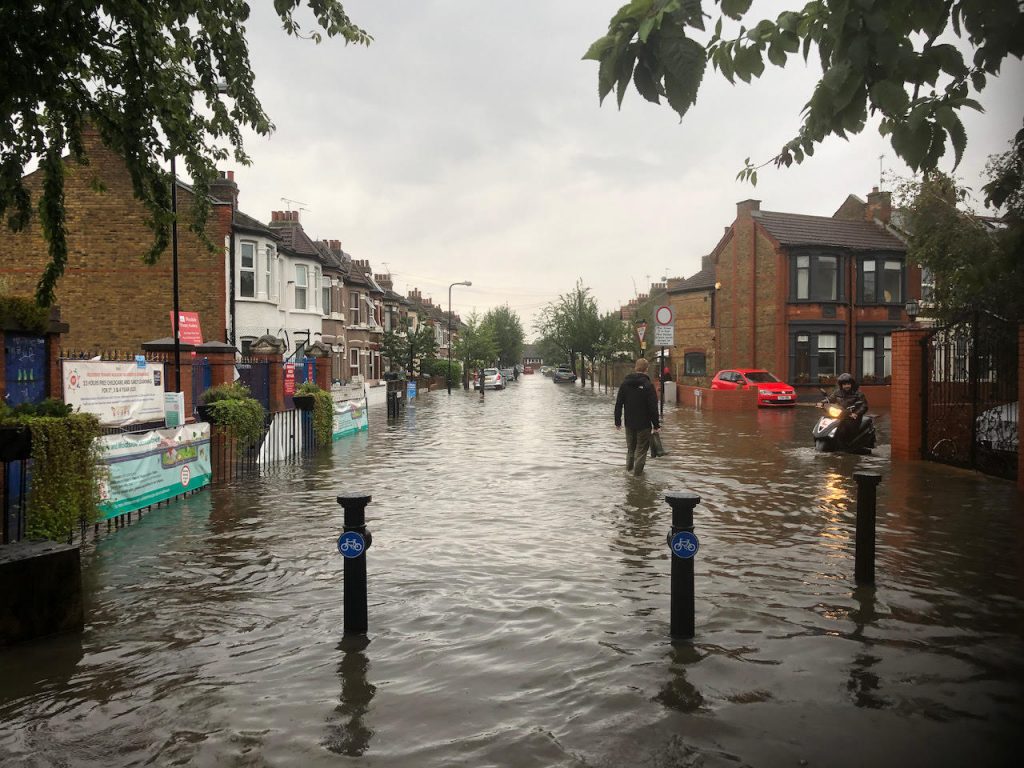
A scene from Walthamstow, London on Sunday 25 July 2021 (Photo by Paul Gasson)

By Cameron Conant

On Sunday, I joined a group of my fellow parishioners and campaigners in Walthamstow, London for a meeting about our ‘Just Transition’ climate campaign, which aims to make London a greener, fairer city. We ordered food, got the meeting space well-ventilated and – mindful of Covid transmission – worked out how we might hold most of the meeting outside. But, unfortunately, it was raining. Not just raining, actually, but something beyond raining. A deluge. It soon became clear that not only would we not be meeting outside, but that something dangerous was happening.

The roof of the church hall (our meeting space) began to leak almost everywhere. After we used every bucket we could find, we grabbed the plastic containers our take-away food had arrived in to collect the rainwater that was pouring into the building. While we were fortunate to be in a building set on relatively high ground, many of my neighbours in Walthamstow were not so lucky and would soon find their lounges, front rooms and kitchens submerged in a foot or more of water.  

In the end, Walthamstow and other parts of London got weeks, perhaps months, of rain in a few hours, with some roads impassable, Tube stations out of service. Of course, we know that with climate change, these sorts of events will become increasingly common for a very simple reason: warmer air holds more water.

Walthamstow got off lightly compared to other parts of the world – Germany had just experienced deadly flooding, as had Belgium, China and India – but what made my situation this past Sunday particularly ironic was that I found myself bailing water out of my Church of England church hall due to a weather event that the Church of England – my denomination – was ensuring would become more frequent.

Sadly, two of the Church of England’s investment bodies – the Church Commissioners and the Pensions Board – still collectively have tens of millions of pounds invested in fossil fuels, the very industry that, quite literally, is fuelling the climate crisis. Despite some clever attempts to rebrand themselves as renewable energy companies, none of the big fossil fuel companies are Paris-compliant; indeed, all have plans to extract more oil, gas and coal than the International Energy Agency says can be safely burned. And yet, remarkably, the Church of England’s Church Commissioners are not merely invested in fossil fuels, but are specifically invested in ExxonMobil, a company that has continually resisted investing in renewable energy, ran a years-long public disinformation campaign to stall action on climate change and was recently caught on camera admitting that they still work behind the scenes to stop climate legislation.

While I can’t say that the Church of England directly flooded my church hall – Walthamstow has flooded before, and it’s difficult to tie any single weather event to human-driven climate change, let alone measure the impact particular investors might have on overall carbon emissions  – we know that putting more carbon into the atmosphere loads the dice and makes it more likely that the world will ‘roll’ certain weather outcomes. I also can’t say the Church of England’s Church Commissioners or Pensions Board are bad people with bad intentions; both believe investor activism will lead to a reduction in emissions, which they say is their goal.

However, it’s time to admit that, despite good intentions, fossil fuel investor activism has failed: after years of engagement, fossil fuel emissions have yet to show any sustained signs of decreasing; fossil fuel companies are still not Paris-compliant; and the climate crisis is becoming ever more serious. Handing fossil fuel companies, whose primary interest is to protect their assets (which are mostly fossil fuels), what effectively amounts to a blank cheque in the hope that these companies will do something other than what they were set up to do, hasn’t produced the change we need.

For these reasons and more, I would implore my fellow Anglicans to join me in calling on the Church of England to divest from all fossil fuels immediately, and to take that same amount of money and invest it in climate solutions. And I would implore any church or diocese (and only 3 of 42 Church of England dioceses have divested) to join Operation Noah’s Global Divestment Announcement in October. Together, we can tell the Church of England’s Church Commissioners and Pensions Board that we literally can’t live like this, and that their financing of the climate crisis must stop.

Cameron is a writer, consultant, campaigner and Operation Noah Trustee.

New book: A Light for the Pathway

Posted in: News

Operation Noah Patron, Bishop David Atkinson, has written a new book exploring the Psalms.

What did the Psalmists of Israel believe? How did they practice their religion? What impact did their faith in God had on the way they handled the struggles and uncertainties of life? How does this speak to us today?

A Light for the Pathway explores some themes which underlie the faith of the psalmists; for example, covenant, creation, law, justice, humanity, suffering, lament, restoration and pilgrimage. Holding these together is the overarching theme of God’s steadfast love throughout their history. The psalms are prayers and praises, often used in temple worships, some intimate and personal, many corporate and full of thanksgiving. Some are celebrations of the kingly rule of God over all creation. How do we Christians today approach this ancient hymn book, which is full of poetic imagination and deep spirituality? How can it help our own journeys on our pathways of faith and hope? This side of the life and death and resurrection of Jesus, can we hear in the psalms words of comfort for our struggles of faith, as well as joy in our worship, in today’s confusing world?

Bishop David Atkinson, former Fellow of Corpus Christi College, Oxford, is a retired Church of England bishop and a patron of Operation Noah. He is the author of several books, including Renewing the Face of the Earth: a theological and pastoral response to Climate Change.

Order A Light for the Pathway

PRESS RELEASE: Faith institutions divest from fossil fuels and call for just recovery ahead of G7 and COP26

Posted in: News
Date posted: 17 May 2021

As world leaders prepare to meet at the G7 Summit, 36 more faith institutions announce divestment

London, For immediate release

Photo attached / Interviews available

Contact: James Buchanan, Operation Noah: james.buchanan@operationnoah.org, +44 7801 570 653

Today, 36 faith institutions from 11 countries announce their divestment from fossil fuels. It comes from institutions in Brazil, Argentina, India, the Philippines, Uganda, Italy, Spain, Switzerland, Ireland, the UK and the United States. These commitments highlight the urgent need to divest from fossil fuels and invest in clean alternatives in response to the growing climate crisis.

This announcement comes from Anglican, Catholic, Methodist, Presbyterian and Baptist institutions, among others. The group includes the Church in Wales, with more than £700 million ($975 million) of assets under management, which voted to divest from fossil fuels at its Governing Body meeting in April. It also includes the Diocese of Bristol and the Diocese of Oxford, the first Church of England dioceses to announce their divestment from fossil fuels, as well as the Baptist Union of Great Britain, the Catholic Diocese of Hallam and the General Assembly of Unitarian and Free Christian Churches.

The global divestment announcement takes place as the UK prepares to host the G7 Summit in June and the UN climate summit (COP26) in Glasgow in November. As governments around the world continue to invest significant sums in economic recovery packages, it is vital that these investments support a just and green recovery from Covid-19. Yet, as the UN has stated, only 18% of the Covid-19 recovery spending announced by the world’s 50 biggest economies in 2020 can be considered green.

The announcement comes a day before the Royal Dutch Shell AGM is set to take place, on Tuesday 18 May. Shell has been coming under considerable pressure as a result of its plans to increase gas production by 20 per cent in the next few years. The Methodist Church announced it had divested its remaining fossil fuel holdings at the end of April, including £21 million of shares in Royal Dutch Shell, citing Shell’s ‘inadequate’ climate plans. The Church of Scotland recently announced that it had also sold its remaining shares in oil and gas companies.

The announcement takes place during Laudato Si’ Week, a celebration of the progress the Roman Catholic Church has made on its journey to ecological conversion following Pope Francis’ encyclical on climate change and ecology. As well as the Catholic Diocese of Hallam, six Catholic dioceses in Ireland and several religious orders are announcing their divestment commitments.

Faith communities have long been at the forefront of the global divestment movement, and have contributed the single greatest number of commitments. Out of the global total of over 1,300 divestment commitments made to date, more than 450 are from faith institutions.

A full list of the 36 institutions divesting from fossil fuels and statements from leaders can be found here.

Statements from leaders:

Bill McKibben, author, environmentalist and co-founder of 350.org, said: “When faith communities divest from fossil fuels, it is a powerful reminder of both the practical and the moral depth of the climate crisis. There is no way to stand up for the most vulnerable people on earth, and to safeguard the rest of Creation, unless you’re willing to take on the fossil fuel industry.”

Rt Revd Dr Joanna Penberthy, Bishop of St Davids in the Church in Wales, said: “Every part of the world is now feeling the effects of climate change. At our Governing Body meeting in April, the Church in Wales declared a climate emergency, pledged ourselves to reach net-zero carbon emissions ideally by the end of this decade, and took the decision to divest from fossil fuels by the end of the year. Whilst these decisions are a major step forward for us, we recognise that there is still much to be done, and we hope that the actions of the churches will encourage governments and industry to work towards alternatives which will help to arrest and overcome the disastrous global warming which is affecting us all.”

Rt Revd Ernesto Manuel, Anglican Bishop of Nampula in Northern Mozambique, said: “Fossil fuel investments increase climate change and impacts on those most vulnerable, and also destabilise communities. We have seen how over 700,000 people in Northern Mozambique have been displaced – many fleeing for their lives in terror from insurgents. Dozens have been beheaded, even children as young as 12. This violence only occurs in the areas where gas prospecting is taking place. Locals are not consulted and nor do they benefit, only suffering the impacts of rising prices, pollution and loss of land. We plead with the international community – take your money out of fossil fuels and invest in renewable energy which is decentralised, benefits local people and does not contribute to climate change.”

Revd Dr Dave Gregory, Convenor of the Baptist Union’s Environmental Network and former Baptist Union President, who is a former meteorologist at the Met Office and the European Weather Centre, said: “It was inspiring to hear so many voices from across the generations and different parts of the Baptist Together family recognising the importance of the decision to divest from fossil fuels, and agreeing that this was the way we need to walk with Jesus together in the face of the climate and environmental crisis which for many in our world is an immediate climate emergency.”

Rt Revd Vivienne Faull, Bishop of Bristol in the Church of England, said: “In taking seriously our response to the climate emergency, I’m pleased to be able to share that the Diocesan Board of Finance (DBF) has made this commitment to disinvest from fossil fuels. Care for creation is a core mark of mission for the Church, and this is an important step towards realising our net zero carbon aims.”

Rt Revd Ralph Heskett, Catholic Bishop of Hallam, said: “The Diocese of Hallam divested of the most damaging fossil fuel companies many years ago. In recent months, we have decided to divest of the remainder of our investments with fossil fuel companies and instructed brokers to actively seek opportunities for investing in companies involved in renewable forms of energy. The Diocese continues to review our actions and investments to care for our common home.”

James Buchanan, Bright Now Campaign Manager at Operation Noah, said: “As the UK prepares to host the G7 and COP26 this year, it is hugely encouraging to see so many Churches and faith groups announcing their divestment from fossil fuels. We urge governments around the world to follow their lead by ending support for fossil fuels and investing in the clean technologies of the future.”

Tomás Insua, Executive Director of the Global Catholic Climate Movement, said: “Our common home cannot take any more dirty fossil energy, so today’s announcement is great news. It’s heartening to see how Catholic institutions are implementing the Vatican’s fossil fuel divestment guidelines, in tandem with so many other faith-based institutions. I hope it inspires many others to follow suit, decisively responding to the cry of the earth and the cry of the poor.”

ENDS

Contact: James Buchanan, Operation Noah: james.buchanan@operationnoah.org, +44 7801 570 653

Notes for editors:

1. Operation Noah is a Christian charity working with the Church to inspire action on climate change. It works with all Christian denominations. operationnoah.org

2. Laudato Si Week https://laudatosiweek.org/ 

3. The Church in Wales Governing Body declared a climate emergency and voted overwhelmingly to divest from fossil fuels in April 2021. https://www.churchinwales.org.uk/en/news-and-events/church-declares-climate-emergency/

4. According to UN analysis, just 18% of Covid-19 recovery spending announced by the world’s 50 biggest economies in 2020 can be considered green. https://www.reuters.com/article/us-climate-change-un-idUSKBN2B21LG

5. Shell is planning to increase gas production by more than 20 per cent in the next few years. https://www.theguardian.com/business/2021/feb/11/shell-grow-gas-business-energy-net-zero-carbon

6. The Methodist Church sold its shares in Shell in April 2021 due to the company’s ‘inadequate’ climate plans. https://www.ft.com/content/9c8195ac-2203-428d-b6c3-91cb717eb084

7. The Church of Scotland announced on 7 May that it had sold its remaining shares in oil and gas companies. https://www.churchofscotland.org.uk/news-and-events/news/2021/articles/church-of-scotland-investor-trust-to-announce-disinvest-from-oil-and-gas

8. In February 2021, the UK Supreme Court allowed a group of 42,500 Nigerian farmers and fishermen to sue Shell in English courts. https://www.reuters.com/world/uk/nigerians-win-uk-court-ok-sue-shell-over-oil-spills-2021-02-12/

9. UK government faces legal action over $1 billion public financing of a Mozambique gas project. https://www.climatechangenews.com/2021/04/23/uk-faces-legal-action-public-finance-mozambique-gas-project/

10. The Global Divestment Announcement Statement can be found at the bottom of this blog: https://brightnow.org.uk/news/global-divestment-announcement-divest-your-church-cop26/
Methodist Church divests from all fossil fuel companies

Posted in: News
Date posted: 4 May 2021

London, 30 April 2021

For immediate release

Contact: James Buchanan, Operation Noah: 

james.buchanan@operationnoah.org, 07801 570 653

The Central Finance Board of the Methodist Church has fully divested from fossil fuel companies, after selling its remaining shares in Shell and Equinor.

The decision followed advice received from the Methodist Church’s Joint Advisory Committee on the Ethics of Investment (JACEI) earlier this month, that no oil and gas companies are currently aligned with the climate change targets set out by the 2015 Paris Agreement. The Central Finance Board divested from coal and tar sands in 2015.

The Methodist Church has sold almost £21m in shares in Shell, as well as selling around £2m of bonds in Norwegian oil company Equinor.

David Palmer, Chief Executive of the Central Finance of the Methodist Church, which oversees £1.3bn of investments, said: ‘The patience of the Church has run out.’ He added: ‘The pace of change across the oil and gas sector has been inadequate and we welcome the recommendation of JACEI to disinvest.’

Revd Dr Stephen Wigley, Chair of JACEI, commented: ‘The Committee has determined that the slow pace of corporate change means that the oil and gas sector is failing to meet the targets set by the Paris Accord. Shell, along with its peers, is currently failing to play a substantial enough role in addressing the climate emergency.’

The decision comes after the Methodist Conference and Methodist Council both supported resolutions on fossil fuel divestment last year. 

The 2017 Methodist Conference passed a motion calling for divestment from any fossil fuel company that had ‘not aligned their business investment plans with the Paris Agreement target of a global temperature rise well below 2 degrees’ by the 2020 Conference.

The Central Finance Board of the Methodist Church previously announced in June 2020 that it would divest from BP and Total.

In the same month, 260 Methodists, including 114 ministers and former Presidents and Vice Presidents of the Methodist Conference, signed a letter calling for the Central Finance Board to complete divestment from all fossil fuel companies. The group highlighted recent Transition Pathway Initiative and Carbon Tracker analysis, showing that no oil and gas companies had aligned their business investment plans with the Paris Agreement goals.

The Methodist Council passed a resolution on divestment in October 2020, after the Methodist Conference: ‘The Council supports the request that JACEI recommends that the Central Finance Board… disinvests before the 2021 Conference from all oil and gas companies which are not currently aligned with the Paris Agreement target of a global temperature rise well below 2 degrees.’ The issue had been referred to Council by the Methodist Conference in July 2020.

Michael Pryke, Chair of the Methodist Zero Carbon Group and former Methodist Youth President, welcomed the news: ‘It’s excellent to see the Methodist Church divesting from oil and gas companies. The prophetic voice of the Church has been heard and the reaction has been amazing to witness. But we mustn’t get complacent, as we still have a lot to do to achieve net zero by 2030.’

Martha Rand, Vice Chair of the Methodist Zero Carbon Group, who proposed the motion on divestment at Methodist Conference as a representative of the Methodist Youth Assembly, said: ‘I’m overjoyed to hear today that the Central Finance Board has fully divested from oil and gas. As Methodists and Christians, it is vital that we show our concern for God’s world and our siblings around the globe through action as well as words. This is a brilliant and important step we have taken. Thanks to everyone who helped make this happen, especially Operation Noah and everyone in the Methodist Zero Carbon Group.’

James Buchanan, Bright Now Campaign Manager at Operation Noah, a Christian climate change charity, said: ‘This is a hugely significant and welcome step by the Methodist Church in responding to the climate emergency, especially as the UK prepares to host COP26 in November. We thank all the Methodists who have campaigned tirelessly to make this happen. We hope other Churches will join them in supporting a just and green recovery by divesting from fossil fuels and investing in the clean technologies of the future.’

ENDS

Contact: James Buchanan, Operation Noah:

james.buchanan@operationnoah.org , 07801 570 653

Notes for editors:

1. Operation Noah is a Christian charity working with the Church to inspire action on the climate crisis. It works with all Christian denominations.

2. The Central Finance Board of the Methodist Church has divested from all oil and gas stocks. https://www.cfbmethodistchurch.org.uk/news/the-central-finance-board-of-the-methodist-church-divests-from-all-oil-and-gas-stocks/

3. In February 2021, US environmentalist and co-founder of 350.org Bill McKibben addressed nearly 400 people at an online event on fossil fuel divestment in the Methodist Church. https://brightnow.org.uk/news/methodist-divestment-webinar-bill-mckibben/

4. The Methodist Council voted in favour of a resolution on fossil fuel divestment in October 2020. https://brightnow.org.uk/news/methodist-council-supports-resolution-fossil-fuel-divestment/

5. The Central Finance Board announced in June 2020 that it had divested from BP and Total. https://brightnow.org.uk/news/methodist-church-divests-from-bp-total-continues-investing-4-oil-companies/6. 260 Methodists, including 114 ministers, signed a letter calling on the Central Finance Board to complete divestment from fossil fuels. https://brightnow.org.uk/news/100-methodist-ministers-call-for-divestment-ahead-of-methodist-conference/

A virtual walk to Glasgow raises funds for Operation Noah

Posted in: Blog, News

Paul Heppleston is walking 300 miles in the lead up to COP26 to raise funds for Operation Noah and Hope for the Future. He told us more about his plans.

‘Walking to Glasgow’ is me walking, virtually, home to the city from which my family originated. My home is 300 miles from the city, so my plan is to walk a total of 300 miles in my local area by mid-October.

I am totally committed to working towards COP26 in various ways, especially using Operation Noah materials and expertise and the support of Hope for the Future.

I currently live in the Peak District and recently began to log my walks around the local area. My particular route to Glasgow – a virtual goal of course – is 300 miles from my house to the SEC Armadillo, the building where COP26 will take place. Afetr that, I shall hopefully be in Glasgow for 3-4 weeks, including being there during COP26. I want to be involved in as much as I can in the conference during those 12 days, perhaps with the Iona Community (to which I belong) and other climate groups who will also be present and active at that time.

I originally planned this as a personal project of symbolic commitment, but people have kindly suggested that I use it to raise funds. I am going to share the proceeds 50-50 with Operation Noah and Hope for the Future, two organisations committed to action against climate degradation and springing from the Christian faith which I share.

You can make a donation to Paul’s efforts on his JustGiving page.

Registered charity number 1138101