Operation Noah is one of 70 organisations who have, today, launched
a 10 -point plan designed to get the UK on track to net-zero emissions whilst
also showing global leadership ahead of hosting the United National climate
summit, also known as COP26, this time next year.
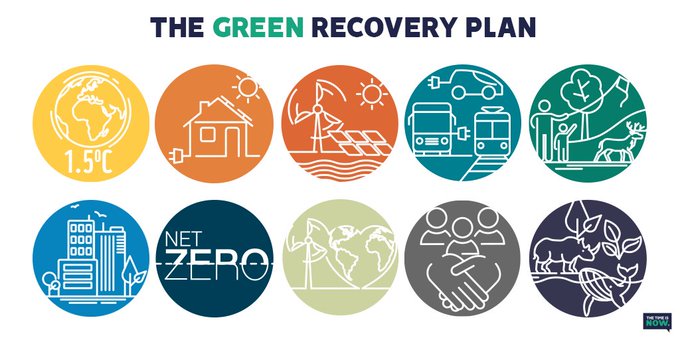
Last month the Prime Minister confirmed that the government will take action to achieve 40GW of offshore wind by 2030, more than enough to power every home in the UK. This was set out as the first point of a 10-point plan for a ‘green industrial revolution’. The full plan will be laid out before the end of this year. In the meantime, a number of NGOs working on climate change has set out our own 10-Point Plan.
The ten points include the UK taking on its fair share of effort to keep global temperatures rises to 1.5°C above pre-industrial levels, investing in domestic energy efficiency and heat pumps which will help us move away from using gas to heat homes, fully decarbonising our power system and ambitious targets for nature restoration. All ten points are set out in this document.
The time to act is now
Actions taken now
by governments to respond to the current health crisis and rebuild our economy
will have an impact for generations to come. Decisions taken today will
determine whether we succeed in our goal to protect the people, places and life
we love from the climate crisis. We can limit global temperature rise to 1.5°C,
halt and reverse the decline of nature and eradicate poverty, or we can lock in
pollution and inequality for generations.
Next year the eyes
of the world will be on the UK as it hosts the UN Climate Summit, COP26. This
is an opportunity to deliver a strong global lead on climate action. The best
way to show this leadership is to put resilience at the heart of our economic
recovery by accelerating the transition to net-zero, restoring nature and
supporting the most vulnerable at home and overseas.
The 10-point plan is part of the Climate Coalition’s
campaign for the government to deliver an economic recovery that sets us on a
path to a cleaner, greener world that works for everyone.
Posted in:Articles, Blog Date posted: 2 October 2020
Churches up and down the country have been running Climate Sunday services since the initiative launched in September. Operation Noah trustee, David Miller, explains how his church put on an online service.
The
opportunity to help our church – currently in the middle of an interregnum – by
proposing a preacher and sermon subject for Sept 6th
was too good to miss! Our church, Whaddon Way Church, is an ecumenical church
in Bletchley, an established town in the south-west of Milton Keynes.
So it was that the Revd Steve Barnes, retired chaplain of our
local hospice, preached at our Zoom service on Climate Sunday. Steve cares
passionately about the environment and for many years he and I have worked
together as participants in our local Green Christian
group.
Steve proposed that, in a similar way that cells reproducing in an
uncontrolled way (cancer) have a catastrophic effect on our bodies, humanity’s
ever-growing consumption of resources and generation of pollution including
greenhouse gases, are destroying the natural world created by God and for which
we are supposed to be exercising care and protection. Particularly in the rich
west, we have allowed ourselves to become addicted to the pursuit of having
more, better, newer, faster, and no longer recognise when enough is
enough.
Whereas any member of the human race should be concerned about the
way their present actions may be compromising the future for our children and
grandchildren, Steve argued that for Christians this represents a spiritual
problem. Referring to the old testament passage we had read (Ezekiel 33:7-11)
Steve explained that we need to become modern-day prophets, warning of the
wrong path being travelled and the consequences for the world God has created.
Failure to do so will result in God holding us responsible.
Jesus came to give us life in all its fulness and to bring joy,
peace and love. When we pray Thy
Kingdom Come, Thy Will be done on earth, we are
effectively saying to God that we desire a world which is in keeping with how
He intends it to be. He wants us to be participants in that project!
After the Zoom service, Steve moved around several of the breakout
rooms and discovered many folks enthusiastic about exploring what actions they
could take to address the environmental challenges that face us. The
trustees have agreed to set up a working group tasked with proposing a way
forward for the church. At the time of writing, the first volunteers have
already come forward…..
Climate Sunday, an initiative proposed by Operation Noah and organised by Churches Together in Britain and Ireland’s Environmental Issues Network, with support almost 20 organisations, is asking churches to hold a climate-focused service between now and 5th September 2021, to make a commitment to take long term action to reduce their own greenhouse gas emissions and to use their voice to tell politicians we want a cleaner, greener, fairer future at the heart of plans to rebuild a strong economy. Find out more.
Watch and listen to other online Climate Sunday services
Revd Vanessa Elston, of St Anne and All Saints South Lambeth,
introduced the season of Creationtide with a stark message about the climate
crisis in this online service.
Cardiff and Penarth URCs held an online service and made
an audio recording.
Revd David Carrington, from the Otter Vale Mission Community,
Devon, offers a Climate Change Sunday reflection in this video
The Diocese of Oxford held an online Climate Sunday service and
made a video recording.
Caroline Harmon, Operation Noah’s Communications Officer, takes a listen to new worship album, Doxecology.
In a world where the environmental message is growing in volume and urgency, there is a distinct paucity of songs that reflect a coherent biblical theology of creation, or of our place as humans within it. Put simply, there are not enough songs that say, ‘We love you, God, and we love your world. – Introduction, Doxecology Study Guide
If you’ve ever found yourself standing in a church service on a Sunday morning (or sitting on your sofa watching an online service) and despaired at the lack of reference to creation care in the worship, or indeed any part of the service, then Doxecology is the album for you.
Two years in the making, Resound Worship has gone on an international search to find 13 songs which aim to bring together doxology (praise) and ecology and the results don’t disappoint. The album includes a range of songs suitable for use in our churches, from the uplifting God of immeasurable might and We are the tenants of the King through to laments such as Hear the Song of our Lament.
Where Doxecology really comes into its own is all the extra materials that accompany it. As well as everything you need to use the songs in your own church (scores, backing tracks, videos demonstrating how to use the songs with limited instruments) there is also a Study Guide for use with small groups and by individuals. It features an impressive list of contributors, including Jack Wakefield from Tearfund, Dave Bookless of ARocha International and Jeremy Williams of Christian Climate Action. The guide even includes three service plans with prayers, poems, all-age activities, song suggestions, videos and more. Perfect if you’re planning a Climate Sunday for your church.
Operation Noah even gets a mention. One of the songs on the album, Tenants of the King, was inspired by Operation Noah’s small group study guide of the same name!
Doxecology and accompanying resources are available from Resound Worship
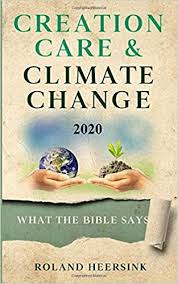
Kevin Shang, an Operation Noah trustee, reviews Creation Care & Climate Change: what the bible says
It seems that everyone is talking about climate change these days. Believers in the church, however, have differing attitudes towards this topic, despite reading the same Bible. Some acknowledge climate change is a real phenomenon but insist the problem will correct by itself. Some sceptics categorise combating climate crisis as a secular issue, which is mainly the responsibility of scientists and policymakers; instead, Christians should focus on matters in the church.
Familiarity is not understanding. I would recommend Creation
Care & Climate Change, by Roland Heersink, to Christians who have heard
a lot about climate change or global warming but seldom explored what the Bible
says about these issues. This is one of the most Bible-based books I have read
on climate change. From Genesis to Revelation, this book will help you to
uncover what the Bible says on climate change and what that means for
God-honouring decisions today.
What particularly impressed me was a new perspective on the
importance of God’s living creatures on earth, including all birds, fish and
animals. ‘For the creation waits in eager expectation for the children of
God to be revealed. For the creation was subjected to frustration,
not by its own choice, but by the will of the one who subjected it, in
hope that the creation itself will be liberated from its bondage to
decay and brought into the freedom and glory of the children of God’
(Romans 8:19-21). ‘He who was seated on the throne said, “I am making
everything new!”’ (Revelation 21:5). Creation and all creatures are
waiting to be released into the new heaven and new earth ahead. Birds, fish and
animals are also part of God’s BIG plan. This makes those creatures a little
more special to me.
I would highly recommend readers follow the author’s
suggestion: read one chapter a day, pray and meditate on relevant Bible verses.
This gives God time to speak to you about climate change issues.
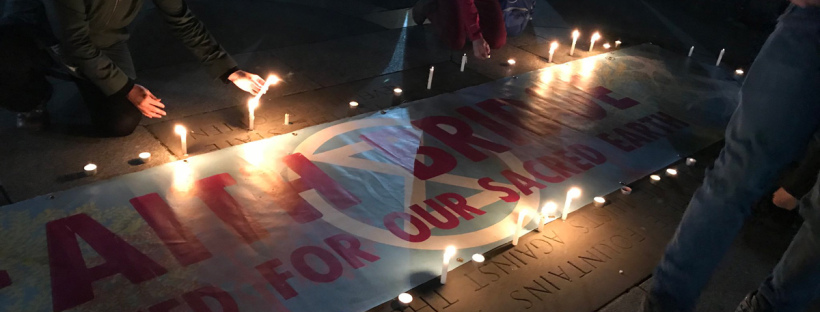
Christian Climate Action will be helping organise Prayer Vigils in three locations during the September Rebellion
Christians to Take Part in Climate Crisis
Protests
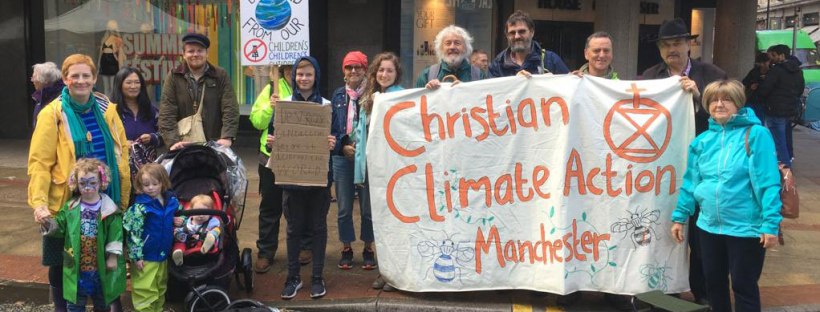
More than 100 Christians are expected to participate in
climate crisis protests around the UK during late August and early September.
Members of Christian Climate Action (CCA) will join with Extinction Rebellion
and a number of other organisations as part of the September Rebellion, taking
place from 28 August and themed around the slogan, ‘We Want to Live’.
CCA, alongside a number of other faith groups,
is organising Prayer Vigils in London, Cardiff and Great Malvern.
The group is also organising an ‘At Home’ Vigil which
people can participate in via Zoom.
Local CCA groups will be joining and organising
local actions around the country from 28 August and national actions in London,
Manchester and Cardiff from 1September.
Melanie Nazareth, a barrister, mother of four
and a CCA member, said, ‘Prayer is the foundation of everything we do in
Christian Climate Action. It unites and sustains us and gives us the strength
to act with loving purpose as we seek to be good stewards of God’s creation. In
this vigil our prayers will help us to draw closer to God as we bear public
witness to the message that God loves the creation that we are destroying.’
Community and Ecological Emergency
Bill
One of the key demands of the protests will be
that the UK parliament passes a Climate and Ecological Emergency (CEE) Bill
into law. This bill is calling for:
A serious plan to deal with the UK’s fair share of emissions and to halt critical rises in global temperatures.
Our entire carbon footprint to be taken into account, both in the UK and overseas.
The active conservation and restoration of nature here and overseas, recognising the damage we cause through the goods we import.
Those in power not to depend on future technologies to save the day; these technologies are being used as an excuse for us to carry on polluting.
Ordinary people to have a real say on the right way forward in a Citizens’ Assembly with bite.
The CEE Bill has been developed with members of Extinction Rebellion, members of the successful Big Ask campaign that led to the Climate Change Act (2008) and Power for People. It has been written with contributions from prominent scientists and academics. The Bill has already received support from Kumi Naidoo, (International Executive Director of Greenpeace International (2009–2016) and Secretary General of Amnesty International (2018–2020).
Hannah Malcolm (centre) pictured with other CCA members
Hannah Malcolm, an Anglican ordinand and member of CCA, said: ‘There is no uncritical time to face up to unfolding climate collapse, but the next six months hold a vital window for change as countries plan economic stimulus packages. If used well, these could accelerate global decarbonisation. Government responses to Coronavirus around the world have demonstrated that rapid, coordinated action is possible, and have also shown us the deadly consequences of indifference. The question is, do we have the courage to abandon the usual way of doing things in order to prevent further death and suffering, and to make way for life to flourish?’
Fr Martin Newell at a previous Rebellion
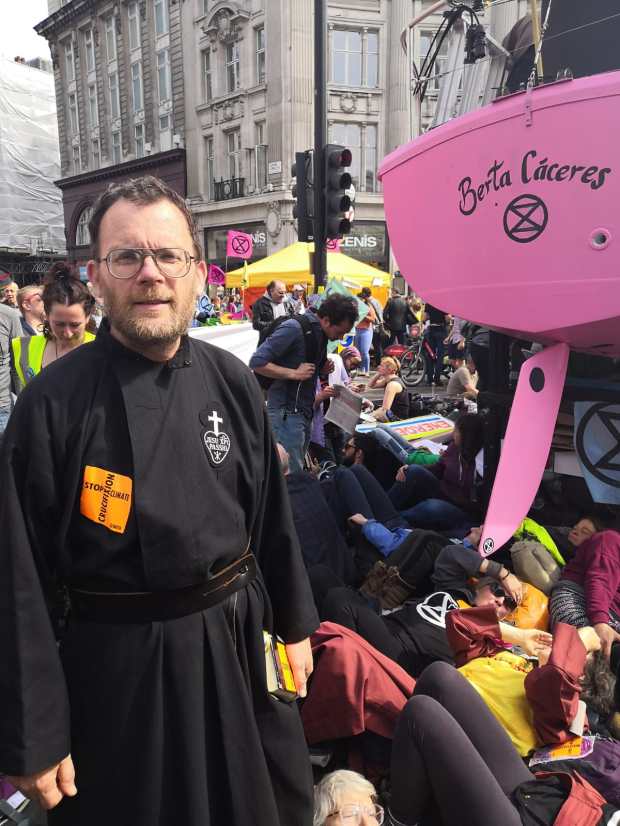
Fr Martin Newell, a Catholic priest from Birmingham and member of CCA, explained why he is taking part: ‘We believe that being faithful means taking a stand on the biggest issue of our time. If you agree, please get involved – there’s lots of work to be done, both on the ground or from home if travelling isn’t viable. When Jesus said to James and John, “Follow me,” they stood up, dropped their fishing nets and did just that. As disciples of Christ, we are called to take action. Will you stand up and do what we are called to or will you remain in the boat?’
In 2018, Operation Noah produced a statement of our position on Extinction Rebellion. It can be read here.
While all eyes have been turned, for the last five months, to the Covid-19 pandemic Bill McGuire, Professor Emeritus of Geophysical & Climate Hazards at UCL and a regular guest blogger for Operation Noah, has noticed that news about global heating and resulting climate breakdown has been coming thick and fast.
Hardly
surprisingly, most of the news about global heating and climate breakdown has
been bad recently – some very bed – but there have also been small nuggets of
good news hidden amongst the gloom.
Every cloud,
even the darkest, has a silver lining. As much of the world went into lockdown
during March, so transport and much of industry and commerce ground to a halt.
The welcome result was a sudden fall in air pollution and carbon emissions.
Despite easing of lockdown, the International Energy Agency calculates that
global emissions for 2020 could be down by as much as six percent, which would
wipe out the growth in emissions over the last five years or so.
This is a
figure not to be sniffed at, but it needs to be considered in context. To avoid
catastrophic climate change, emissions must fall by around 7.5 percent every
year for the next decade. The rather depressing reality is, therefore, that
even a global pandemic has not been sufficient to bring about emissions
reductions on the scale that we need. Still, it is a welcome hiatus, and one that
we need to make the most of by pushing for a ‘new normal’ that is far greener
than the old.
Fire and
ice
Meanwhile, the
vast quantities of carbon we have already pumped into the atmosphere have
continued to play havoc with the weather and climate systems. During June,
temperatures in the Siberian Arctic reached an all-time record high of 38°C,
driving wildfires across millions of acres of tundra, which released vast
quantities of soil carbon into the atmosphere. In fact, Siberia has been baking
in unseasonal heat since January, marking a heatwave that a new study by the UK
Met Office confirms, would have been impossible without human-induced global
heating. Not to be left out, Antarctica also recorded its hottest ever day in
February, when the temperature in West Antarctica touched a balmy 20.75°C.
Warnings
from Antarctica
There has been
more bad news from down under too. New research looking at past warming
episodes – published in the journal Science –reveals that the
colossal floating ice shelves that encircle much of the Antarctic landmass, are
capable of sliding into the sea five times faster than they are at present.
This means that as our world continues to heat up, so these ice shelves could
start disappearing at a rate as high as six miles a year. It is a sobering fact
that, the last time the ice shelves retreated at this rate – around 12,000
years ago – sea levels were climbing at an astonishing six centimetres a year,
which is 12 times the current rate.
A sensitive
climate
Probably the most disturbing news came courtesy of new modelling undertaken for the Intergovernmental Panel on Climate Change (IPPC) 6th Assessment, due out next year. There is an almost magical number in climate change science, which is the value of so-called climate sensitivity. This, in simple terms, is the amount the planet will eventually heat up if the concentration of atmospheric carbon dioxide is doubled from pre-industrial times, when it was around 280 parts per million (ppm). In other words, 560ppm. Originally thought to be around 3°C, the latest models suggest that the worst-case figure for climate sensitivity could be as high as 5°C, which is a terrifying finding.
Atmospheric
carbon levels are currently around 417ppm, and before the pandemic lockdown
they had been climbing at about 2.4ppm a year. If we get back to this rate once
Covid-19 dies back, then a doubling of atmospheric carbon dioxide could be
achieved as soon as 2080. This would lock in an eventual global average
temperature rise great enough to bring our civilisation to its knees.
This is, it
has to be said, a worst-case scenario, and an even more recent study – the
results of which have just been released – argues that climate sensitivity is
more likely to lie between 2.6°C and 3.9°C. This is less bad news, but still
very bad. Furthermore, past experience has shown that global heating and
climate breakdown observations typically meet, and often exceed, earlier
worst-case predictions.
I started off
this post with some good news, so let’s end with another optimistic story.
New analysis,
published earlier this month in Nature, demonstrated that sprinkling
rock dust on farmland – on a big enough scale – could capture as much as two
billion tonnes of carbon a year. This rather simple method works because as the
rock dust – common basalt is best – weathers, so it absorbs carbon from the
atmosphere and locks it in. The method is also relatively cheap and fertilises
the soil at the same time.
Of course, two
billion tonnes is only about one twentieth of current annual carbon emissions
and it would require a huge and co-ordinated international effort to accomplish.
However, barring the unlooked for Covid-driven emissions cuts, it is the first
positive news on the climate front in a very long time. It also flags the fact
that, while we may be in desperate straits, there are always approaches we can
take to begin to challenge global heating and catastrophic climate breakdown.
That is, if we really want to.
Bill McGuire is Professor Emeritus of Geophysical & Climate Hazards at UCL and author of Waking the Giant: How a Changing Climate Triggers Earthquakes, Tsunamis and Volcanic Eruptions. He was a contributor to the IPCC 2012 report on climate change and extreme events and disasters. His new book, SKYSEED, an eco-thriller about climate engineering gone wrong, is published in September.