We are looking for two enthusiastic and motivated people to join our growing team at this key moment for Operation Noah’s Bright Now campaign. The Bright Now campaign encourages UK Churches to divest from fossil fuel companies and invest in climate solutions – working with partners in the UK and globally.
Operation Noah has received grant funding to scale up our work with UK Churches and faith institutions on investment in climate solutions, such as renewable energy. We will also work with partners on a campaign to encourage the Church of England to increase tree coverage on its land and improve its land management practices, given the urgent climate and biodiversity crises.
The successful candidates will be employees of Operation Noah. These jobs are based in our office near London Bridge and can involve some home working, subject to agreement. (Operation Noah will continue to be responsive to changing circumstances and to ensure the safety of our employees.)
We expect to hold interviews on Monday 13 December (for the Bright Now Campaign Manager role) and Wednesday 15 December (for the Bright Now Campaign Officer role).
If you would like to apply for either of these roles, please email admin@operationnoah.org by Sunday 5 December with your CV and a cover letter.
The Revd Dr Darrell D Hannah, Rector of All Saints Church, Ascot, and Chair of Operation Noah’s Board of Trustees, urges The Tron Church in Glasgow to re-consider its opposition to preaching ‘climate change’.
Into my email inbox this afternoon arrived the daily news summary, from a Christian perspective, collected and edited by the good people at Premier Christian Radio. I often glance at the headlines without taking time to read any of them, but today one headline caught my eye and my immediate concern: “Putting the gospel before climate change.”
The article assumes that preaching Christ crucified and “preaching climate change” are two different things. As a preacher who seeks, Sunday by Sunday, to preach “Christ and him crucified”, and who is convinced that climate change is causing the crisis of our age, I was struck by the unnecessary and illogical polarity of this assumption.
I am sure Dr Philip would agree with me that Christ died for our sins, that Christ went to the cross because of human selfishness and greed and because of the human tendency to choose love of self over love of God and love of others. I would hope that after a moment’s reflection, he might also recognise that it is just these things, selfishness, greed and love of self, that also drive the consumerism and the reckless exploitation of the world’s resources and threaten the very survival of future generations.
At one point, Dr Philip asserts (in all caps), “THE MOST URGENT NEED IS FOR THE WORLD TO REALISE THAT ITS PRIORITIES ARE ALL WRONG.” I cannot imagine that many climate activists would disagree. In fact, many would respond with a hearty “Amen!” It is just those misplaced priorities which impedes governments, corporations and individuals from changing direction, even when they admit that our current direction will lead to disaster. And it is just those immoral and sinful priorities which led Jesus to Golgotha.
Later in the article, Dr Philip conjectures that if Jesus were to produce a banner for COP 26, it might display his saying recorded in Luke 12:56: “You hypocrites! You know how to interpret the appearance of earth and sky, but why do you not know how to interpret the present time?”
While he does not fully spell out his reasoning, it is difficult not to suspect that Dr Philip here alludes to his belief that we are living in the last days; the climate crisis would then be one of the “birth-pangs” of the Age to Come mentioned by Jesus in the Gospels (Mark 13.8; Matt. 24.8). If climate science is correct, Dr Philip may well be proven right. If humans do not change direction, we will succeed in making the world uninhabitable for humans, as well as for many species of the animal and plant kingdoms.
If this were to happen, I cannot see how the promises of Jesus and the apostles could remain true if the return of Christ, the resurrection of the dead and the Final Judgement did not immediately follow such an ecological disaster. While we are encouraged in Scripture to “hasten that Day” (2 Peter 3.12), I cannot believe the Apostle Peter meant that we should do so by continuing to treat God’s world as if it is ours to pollute and exploit and consume at will.
When the day of judgement comes, we will be answerable to God for how we have used, and misused, His world, and for the consequences of our actions on our neighbours—regardless of whether that day is near or far off. But if it is near, we dare not put off addressing how we as humanity and as Christians contribute, and continue to contribute, to the climate crisis by our unchristian life styles.
In short, to preach Christ crucified in this day and at this hour necessitates that we call attention to the climate crisis and our part in creating it. And to fail to “preach climate change” is to fail to preach Christ crucified.
Revd Dr Darrell D Hannah is the Rector of All Saints, Ascot, and the Chair of Operation Noah. An American, Darrell moved to the UK in 1992 to pursue a doctorate at the University of Cambridge in Christian Origins and has lived here ever since. He moved into full-time parish ministry in 2008 after academic posts at the universities of Sheffield, Birmingham and Oxford. When time allows, Darrell continues to write and publish in the areas of Second Temple Judaism, the New Testament and early Christianity.
Catholic Bishops’ Conference of Scotland and UK faith groups representing nearly 2,000 local churches announce divestment before UN Climate Conference
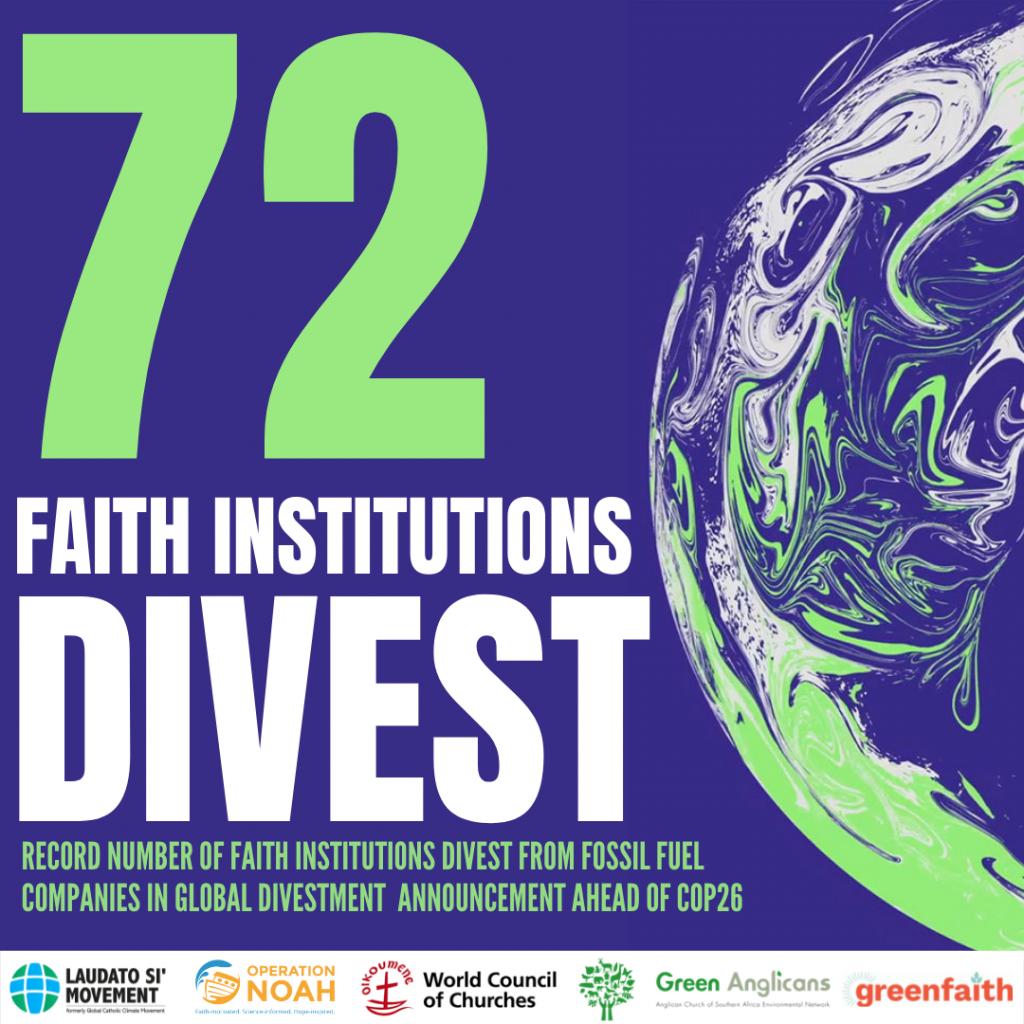
Tuesday 26 October 2021: Today, five days before the UN climate conference, COP26, in Glasgow, and four days before the G20 Summit in Rome, 72 faith institutions, including 37 from the UK, announce their divestment from fossil fuels in the largest-ever joint divestment announcement by religious organisations.
The global divestment announcement comes from faith institutions with more than $4.2 billion of combined assets under management in Australia, Ireland, Italy, Kenya, Nepal, Peru, Ukraine, the UK, the United States and Zambia.
Participating institutions include the Catholic Bishops’ Conference of Scotland; the Central Finance Board of the Methodist Church; the Presbyterian Church of Wales; the Presbyterian Church in Ireland; 15 Catholic dioceses in the UK and Ireland, including the Archdioceses of Glasgow, St Andrews & Edinburgh, Birmingham and Southwark; the Church of England Dioceses of Truro and Sodor & Man; and the Buddhist religious movement Soka Gakkai International – UK. The UK Churches and dioceses involved in this announcement represent nearly 2,000 local churches.
It follows the recent call from Pope Francis and other faith leaders to global governments to address the ‘unprecedented ecological crisis’ ahead of COP26 and calls from an international alliance of grassroots multi-faith activists who have called for an immediate end to all fossil fuel finance. Today’s announcement shows an increasing number of Catholic institutions are responding to the recent Vatican recommendation to divest from fossil fuel companies and invest in climate solutions.
Bishop Bill Nolan, Bishop of Galloway and Lead Bishop on the Environment for the Catholic Bishops’ Conference of Scotland, said: ‘The bishops decided that disinvestment would show that the status quo is not acceptable and further, that given the harm that the production and consumption of fossil fuels is causing to the environment and to populations in low income countries, it was not right to profit from investment in these companies. Disinvestment is a sign that justice demands that we must move away from fossil fuels.’
The fossil fuel divestment movement has grown exponentially in recent years. According to a new report published today, more than 1,485 institutions with combined assets of over $39 trillion have made some form of divestment commitment, up from a starting point of $50 billion in 2014. Faith institutions have been at the forefront of the global divestment movement, representing more than 35% of total commitments. Glasgow, Rio de Janeiro, Paris, Seattle and Auckland are also announcing their divestment commitments today, joining the C40 Divest / Invest Forum supporting the advancement of divestment of their city and pension funds.
The International Energy Agency (IEA) stated in its recent Net Zero by 2050 Roadmap that there can be no new coal, oil and gas developments if the world is to limit global warming to below 1.5°C and prevent catastrophic climate impacts. As world leaders prepare to meet at COP26, the UK Government is coming under increasing pressure over plans for the Cambo oil field off the coast of Scotland, supported by oil giant Shell, which would release emissions equivalent to the annual carbon pollution from 18 coal-fired power stations.
Last month, more than 20 Southern African Anglican bishops including the Archbishop of Cape Town, the three bishops of Mozambique and the Bishop of Namibia called for an immediate halt to gas and oil exploration in Africa. They said that ‘a new era of economic colonialism by fossil fuel companies is well underway’ and that ‘Africa’s natural habitats are being destroyed at an alarming rate through the extraction of oil and gas’.
James Buchanan, Bright Now Campaign Manager at Operation Noah, said: ‘As the UK prepares to host COP26, we are delighted that 37 UK faith institutions have decided to divest from fossil fuel companies and join this record global divestment announcement. We call on the UK and global governments to end fossil fuel subsidies and bring an immediate halt to new oil and gas exploration, including the Cambo oil field.’
A full list of the 72 institutions divesting from fossil fuels and quotes from leaders can be found here.
Statements from leaders:
Archbishop Bernard Longley, Archbishop of Birmingham, said: ‘Our commitment to divestment in fossil fuels is a response both to the cry of the earth and of the poor, taking us one step further towards its consolation. We join many other faith organisations who are making the ethical choice to ‘take care not to support companies that harm human or social ecology… or environmental ecology’, as Pope Francis calls us to do in the Vatican’s manual Journeying Towards Care For Our Common Home. To see so many united in this aim gives me great hope for the future.’
David Palmer, Chief Executive Officer of the Central Finance Board of the Methodist Church, said: ‘The pace of change across the oil and gas sector has been inadequate and falls well below the targets set at COP21 in Paris. We hope that COP26 will refresh these targets and we look forward to joining other faith groups in Glasgow next month in calling for immediate action to address the climate emergency.’
Revd Evan Morgan, Moderator of the Presbyterian Church of Wales, said: ‘Our General Assembly passed a resolution to divest from fossil fuels this year as part of our new green environmental policy as a denomination. We realise time is running out and to safeguard the planet and fulfil our role as stewards of God’s creation, the Church amongst other organisations must act. The time for words, however well meaning, is over and actions now are the order of the day and to be proactive in our response to the challenges of the climate crisis.’
Rt Revd Dr David Bruce, Moderator of the Presbyterian Church in Ireland, said: ‘At its General Assembly on 5 October 2021, the Presbyterian Church in Ireland directed its trustees to employ a new strategy in relation to companies producing fossil fuels or deriving part of their turnover from their use. Specifically this will mean divesting from those companies that derive more than 10% of their turnover from oil and gas extraction and engaging with other companies which are major users of fossil fuels. We believe that our investment policies should be informed by the biblical understanding of creation that leads to a commitment to God’s world and to our global neighbours.’
Robert Harrap, General Director of Soka Gakkai International – UK, said: ‘As a Buddhist organisation based on a philosophy of respect for the dignity of life and the non-duality of the individual and the environment, it is important to us that we invest sustainably and responsibly. Our trustees have decided to divest from fossil fuels because this is a key way to protect our precious planet and the people most at risk from the climate crisis.’
Bishop Luke Pato of Namibia said: ‘We are guardians of the land for the generations to come. Namibia is the driest country south of the Sahara and our ground water is the heritage we leave for our children and grandchildren. We cannot risk drilling operations that pollute precious water sources, abuse indigneous rights and threaten the heritage site of the Okavango Delta.’
Lorna Gold, Chair of Laudato Si’ Movement, said: ‘People of faith are divesting at scale from coal, oil and gas, calling on the G20 in Rome and world leaders at COP26 to finally conclude that there is no future for fossil fuel finance. Fossil fuel divestment is a key part of ensuring a just transition for all, especially communities around the world who have done least to cause the climate crisis.’
Revd Dr Rachel Mash, Environmental Coordinator of Green Anglicans, said: ‘Faced with environmental devastation, pollution of precious water sources and abuse of land rights caused by fossil fuel companies, it is easy for those on the frontline of climate change to feel overwhelmed by the power of these corporations. When we hear that faith communities are taking their money out of these companies, it rekindles hope that we are not alone.’
Revd Fletcher Harper, Executive Director of GreenFaith, said: ‘In the midst of a climate emergency, fossil fuel divestment is a moral imperative. More and more religious groups – Muslim, Hindu, Buddhist and Jewish as well as Christian – must continue to add their names to the growing list of divestment commitments, and must also lead the way by investing in ensuring access to clean energy for absolutely everyone – particularly the 800 million people who lack electricity.’
1. Operation Noah is a Christian charity working with the Church to inspire action on climate change. It works with all Christian denominations. operationnoah.org
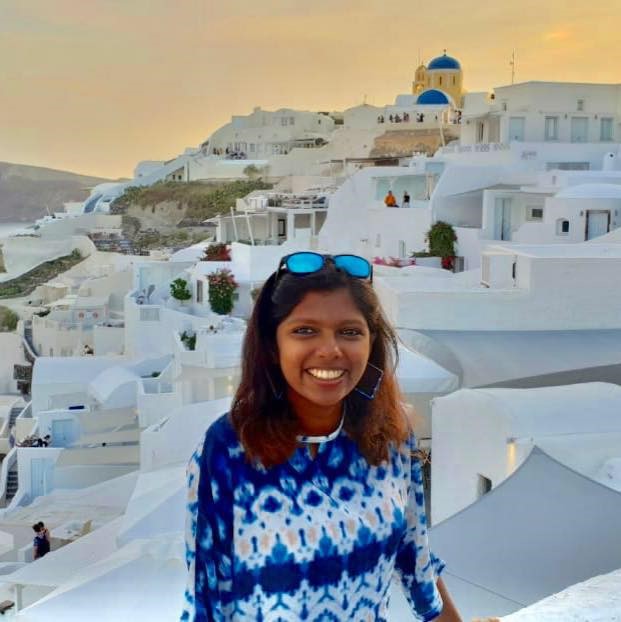
Shilpita Mathews, an Operation Noah trustee, environmental economist and member of Young Christian Climate Network, will produce daily videos from COP26 in Glasgow that we will share via Operation Noah’s social media channels. Here, Shilpita reflects on being an official UN observer at COP26 and what she hopes to achieve.
I will be going to the United Nations’ climate change conference, COP26, in Glasgow. As an official UNFCCC observer (United Nations Framework Convention on Climate Change), I will be in the blue zone of the conference where key negotiations will take place and where delegates from 197 parties and observer NGOs will also be, including observers from Christian NGOs.
Countries will be making important decisions around adaptation and resilience, loss and damage, and climate financing for developing countries. And numerous organisations, such as YCCN, Tearfund and Christian Aid, are calling on leaders to be much more ambitious in their commitments.
What is the Christian
Climate Observers Program?
I have been selected as an observer as part of the Christian Climate Observers Program (CCOP). This programme trains the next generation of climate leaders from a Christian and missional perspective. CCOP is organised by a consortium of organisations, such as the Lausanne Network and A Rocha. At the conference itself, I will be representing the World Evangelical Alliance.
My goals for COP26
Ensuring social and racial justice is at the heart of climate action
I will use this opportunity to call on UK Christian leaders to link climate action with racial and social justice. Most importantly, I want to diversify the conversation on climate justice by calling youth from minority communities to make connections globally and to take climate action locally.
As a trustee for Operation Noah and a member of the Young Christian Climate Network, I am eager to build on the momentum of COP26 as Christian NGOs respond to the call for climate justice. Following CCOP, I hope to speak at churches, write about my experiences for Christian charities and use my learnings from CCOP to drive climate action amongst Christians.
“It seems quite inexplicable to me that there are some Christians who claim to love and worship God, to be disciples of Jesus, and yet have no concern for the earth that bears his stamp of ownership. They do not care about the abuse of the earth, and indeed, by their wasteful and over-consumptive lifestyles, they contribute to it.”
Bringing faith leaders and the private sector together
As someone working in the private sector as an economist, I believe that we can work #TogetherForOurPlanet. Business and industry play a key role in financing climate solutions, with private finance accounting for the majority of climate finance in 2018-2019. Similarly, faith groups represent 80% of the world’s population and play a powerful role in advocating for change, as demonstrated in the leadership of Pope Francis. COP26 is an opportunity to build bridges at a time of crisis.
COP26 is bound to be a rewarding but overwhelming experience and I would appreciate your prayers, support and encouragement.
You can follow my COP26 journey in three ways:
CCOP21 newsletter: Please fill out this form to receive daily prayer newsletters from COP26 by the CCOP21 team.
60-second Twitter reflections: While at COP26, I will be posting a 60-second reflection every day. You can follow me on Twitter (@ShilpitaMathews) or via the @OperationNoah handle.
Join ongoing events: There are many ways to support COP26 events in Glasgow, but I would specifically like to invite you to join Young Christian Climate Network in celebrating our 4 month-long Relay to COP26. Join us online or in-person as we give thanks and look ahead.
Thank you!
Finally, thank you for your incredible support in helping me reach 125% of my crowdfunding target to attend COP26! I am so thankful for your generosity and for your encouragement in this journey.
Shilpita Mathews holds degrees from Cambridge University and the London School of Economics. She is an environmental economist and was a co-author of the Third UK Climate Change Risk Assessment.
Canon Dr Rachel Mash co-authored this powerful resolution, which this month is being put before the All Africa Conference of Churches and the Council of Anglican Provinces of Africa for endorsement. Rachel is the environmental coordinator for the Anglican Church of Southern Africa, and was recently awarded the Cross of St Augustine by the Archbishop of Canterbury for her environmental work across the Anglican Communion.
Africa, our home, is a continent of spectacular beauty and abundance. It still has remnants of its unique and priceless wildlife in areas of great variety, biodiversity, and wonder. The land has deep rooted cultural and traditional significance and 80% of the Continent’s people depend on small scale farmers for their food.
A new era of economic colonialism by fossil fuel companies is well underway. This is supported by self-serving governments. They are enticed by the promise of job creation and finance for ‘development’ while ignoring the harsh reality of the climate crisis, the ravages of which are being felt across the Continent. Biodiversity loss, exacerbated by catastrophic climate change will have dire consequences for all life on this planet and Africa will be severely affected.
Africa’s natural habitats are being destroyed at an alarming rate through the extraction of oil and gas, with many new projects in the pipeline. Known in Nigeria as the curse of “black gold”, fossil fuel extraction is polluting the water and the land. Oil companies are abusing the rights of indigenous and rural people and forcing them off their land. Oil and gas exploration and exploitation are leading to political destabilisation and increased violence.
The choices we make now will determine the future of Africa. We face species extinction, widespread disease, life-threatening temperature extremes, droughts, ecosystem collapse, and rising sea levels, floods, storms, and wildfires, unless there is transformational change by individuals, communities, businesses, institutions, and governments.
Africa is a continent richly blessed with sun and wind. Investment in renewable energy, now the cheapest form of energy worldwide, will create far more jobs and long-term savings. Renewable energy will be generated without the health-damaging pollutants of fossil fuels or global warming that will push the world past a catastrophic 1.5°C increase in temperature. The declining worldwide demand for fossil fuels will also leave Africa with a legacy of stranded assets.
Yet rather than halting fossil fuel extraction, many governments are actively encouraging exploration for oil and gas reserves by foreign companies. This, despite each country’s commitment to the Paris Agreement and their promise to formulate nationally determined contributions (NDC) of climate changing emissions.
Across the continent, foreign companies, supported by African governments, are putting profit before planet:
ReconAfrica, a Canadian oil and gas company, is drilling for oil and gas in the Kavango Basin in north-east Namibia. The company’s 25-year production licence covers over 34,000 square kilometres. Major oil extraction threatens scarce water supplies and is likely to cause widespread ecological destruction to the Okavango Delta, a UNESCO World Heritage Site. It would also disrupt traditional livelihoods and displace indigenous communities.
The Virunga National Park in the DRC is a ‘protected’ UNESCO World Heritage Site. It has a wealth of biodiversity but is threatened with oil exploration. UNESCO has appealed to the DRC government to cancel all oil exploration permits and focus rather on longer term sustainable development opportunities.
The plan to build a heated pipeline that will carry crude oil from western Uganda through Tanzania to the Indian Ocean, the East African Crude Oil Pipeline (EACOP), will damage fragile ecosystems and displace families from their land. The Ugandan and Tanzanian Governments, the French oil company Total, and the China National Offshore Oil Corporation (CNOOC) have partnered in this agreement.
Multiple foreign corporations (including Total) have invested in the offshore gas reserves of northern Mozambique. In spite of promises, the vast development has not benefitted local communities. People are losing their ancestral land and culture. Many young men have joined the Al-Shabab insurgency group making brutal attacks. Nearly 900,000 people have been internally displaced due to the violence. The Quirimbas National Park, a UNESCO Biosphere Reserve, will also be exposed to the impacts of dredging, waste disposal and construction.
As people of faith, we believe we have been given responsibility to care for, protect and preserve Africa’s magnificent creation.
The Bishops of the Anglican Church of Southern Africa call for:
• The immediate cessation of fossil fuel exploration across Africa.
• The application of effective climate justice so that countries of Africa, disproportionately affected by climate change, may be enabled to leapfrog the polluting fossil fuel era into the clean renewable energy era.
• An end to bribery and corruption by foreigners and multi-national companies to secure contracts from political leaders, with disastrous consequences for local communities.
• A decisive and determined shift by governments to embrace a transition to a renewable energy future with its enormous job creation potential so that people and planet may breathe and thrive.
• The recognition of Ecocide as a crime in national and international law. Ecocide is causing irreparable damage and destruction to ecosystems and harming the health and wellbeing of species, including humans.
This autumn, Operation Noah are launching a national listening campaign around the Church of England’s fossil fuel investments, and we’re inviting you to join us for one of two online training sessions in October to learn how to lead a discussion in your church, parish or local community with people who might be interested in this issue.
Join us for a free, 1-hour training session on Zoom on either Tuesday 12 October 2021 at 7pm, or on Thursday 14 October 2021 at 7pm, by registering here.
A listening campaign is a series of listening meetings or gatherings where people discuss an issue of mutual concern and ultimately decide what they want to do about it. In this campaign, we’re training leaders to lead discussions with groups of 6-12 people (either in-person or on Zoom) about the Church of England’s fossil fuel investments – not only the national Church’s investments, which total £55 million, but also fossil fuel investments that individual Church of England dioceses still hold.
The purpose of any listening meeting is to hear how people feel about the issue, to share stories about how the issue impacts people’s lives, and to explore what, if anything, people want to do to change the situation.
Listening meetings help campaigns identify new leaders, empower people to take action on the things that matter to them, and help bring to the surface compelling stories that can be used to speak truth to power.
If you would like to take a look at the resources we’ve developed for this campaign, including a meeting script and PowerPoint presentation on the Church of England’s fossil fuel investments, you can download them below.