Featured

Operation Noah’s Top 10 Moments of 2021

Posted in: Blog, Featured

As we prepare to celebrate Christmas and welcome in the New Year, we’ve selected some of our top moments of 2021 – change that you made possible by supporting Operation Noah! 

This year, our Bright Now campaign has gone from strength to strength. Nearly every major Church in the UK has now divested from fossil fuels, and even the ones that haven’t, such as the Catholic Church in England and Wales and the Church of England – both of which still have fossil fuel investments at a national level – are seeing increasing numbers of dioceses divest.

This year, we also saw the Climate Sunday movement – which we initiated and supported – enable over 2,200 UK churches to hold a climate-themed service, with many of those churches taking action by lobbying their MP or signing up to a church greening scheme.

All of this activity is only possible with your support. If you feel able to give to Operation Noah this Christmas, either through a one-off donation or by giving regularly, we would be incredibly grateful. Your prayers and financial support, quite literally, change the world! 

The Operation Noah Team 
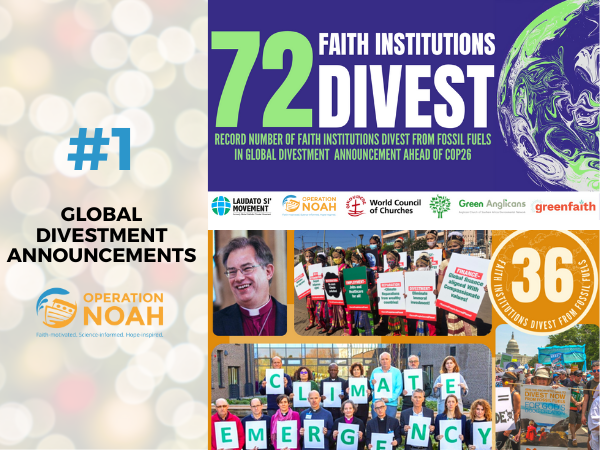
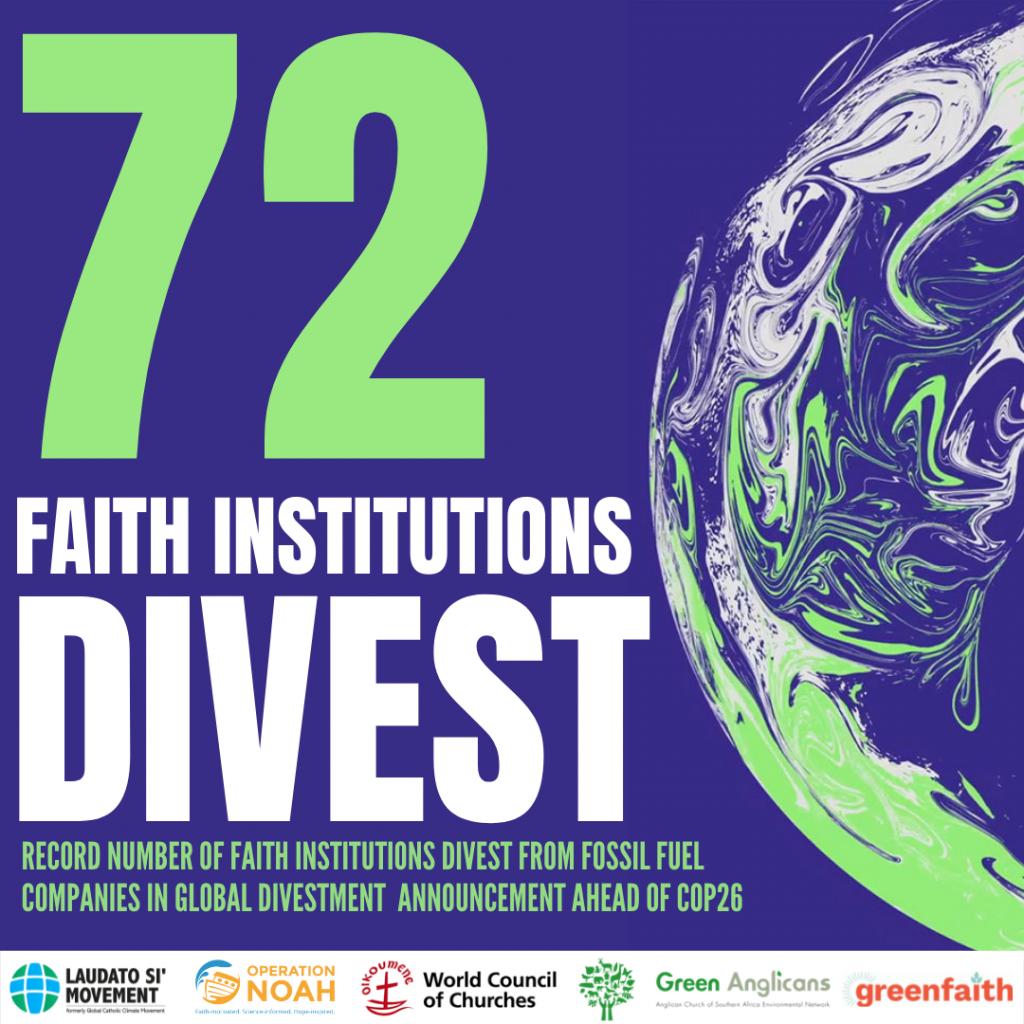
Our top moment of 2021 is the series of Global Divestment Announcements that we organised with our friends at Laudato Si’ Movement, Green Anglicans, World Council of Churches and GreenFaith. This year saw two announcements: one on 17 May, when 36 faith institutions from 11 countries announced their divestment from fossil fuels, and one on 26 October, when 72 faith institutions participated in the largest-ever joint divestment announcement by faith institutions.

The 26 October announcement, which was made just five days before the UN Climate Change Conference (COP26), included 72 faith institutions from six continents with more than £3.1 billion ($4.2 billion) of combined assets under management in Australia, Ireland, Italy, Kenya, Nepal, Peru, Ukraine, the UK, the United States and Zambia.

Of the institutions that joined the announcement, 37 were from the UK; participating institutions included the Catholic Bishops’ Conference of Scotland, the Presbyterian Church of Wales, the Presbyterian Church in Ireland, 15 Catholic dioceses in the UK and Ireland, and two Church of England dioceses, among others.
Started by Operation Noah, Climate Sunday – an initiative to invite churches to hold a climate-themed service before November’s UN Climate Change Conference (COP26) in Glasgow – grew to include almost every major Church in the UK and most of the largest Christian environmental and international development charities. More than 2,200 UK churches held a climate-themed service, and many of those churches also lobbied their MP, signed the Climate Coalition’s letter calling for more ambitious climate action or joined a church greening scheme. Read more about what’s next for Climate Sunday.
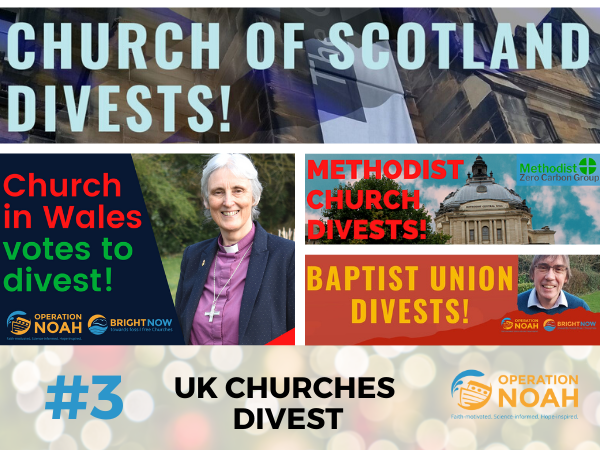
Some of the largest UK Churches divested from all fossil fuels in 2021, including the Church in Wales, the Methodist Church, the Baptist Union and the Church of Scotland. David Palmer, Chief Executive of the Central Finance Board of the Methodist Church, which oversees £1.3 billion of investments, said: ‘The patience of the Church has run out’, adding, ‘The pace of change across the oil and gas sector has been inadequate and we welcome the recommendation…to disinvest.’

Operation Noah made its presence felt at COP26, the UN Climate Change Conference in Glasgow. One of our trustees, Shilpita Mathews, an environmental economist, was an official observer at the conference, and our Bright Now Campaign Manager, James Buchanan, spoke at several events and helped organise a powerful in-person discussion on divestment and climate justice, which we also live-streamed to an international audience. Read more about Operation Noah’s presence at COP26 here.
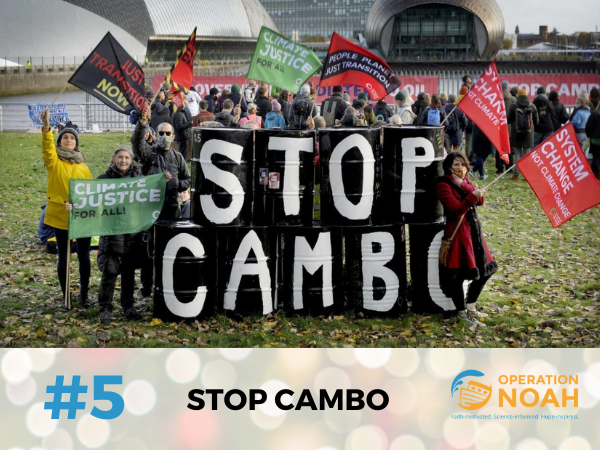
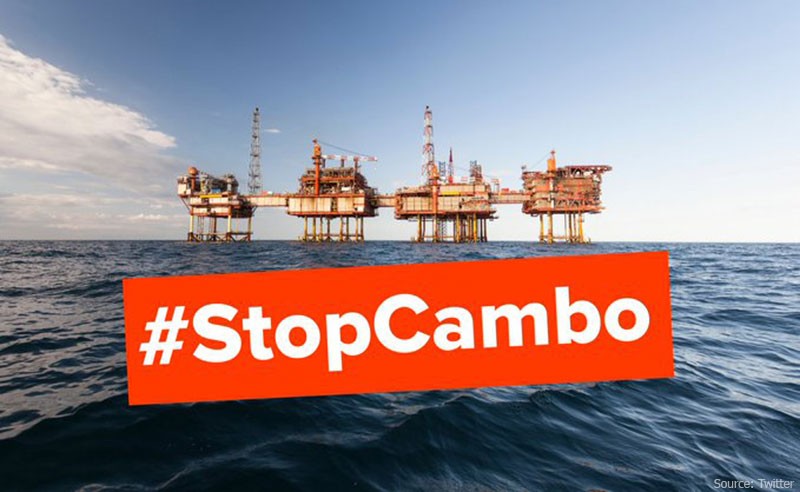
In December, Shell announced that it would no longer fund the Cambo oil field, west of Shetland. While majority stakeholder Siccar Point Energy still hopes to take the project forward with new backers, it is now pausing the project as Shell’s withdrawal means it is unable to keep to the ‘originally planned timescale’. Cambo would produce annual emissions equivalent to 18 coal-fired power stations and is the first of more than a dozen proposed North Sea oil projects. Operation Noah is proud to be an official partner of the Stop Cambo campaign. Read our reaction to Shell’s withdrawal.
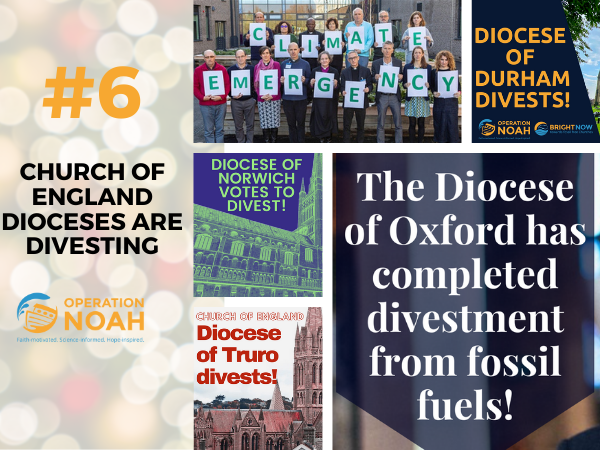
In 2021, we saw a rapid acceleration in the number of Church of England dioceses deciding to divest. Since March, six Church of England dioceses have announced their divestment from fossil fuels, with many others actively considering such a move. This year, the Dioceses of Bristol, Oxford, Sodor & Man, Truro, Norwich and Durham made divestment commitments. Currently, 18 Church of England dioceses have fossil fuel investments, and 18 dioceses have no fossil fuel investments but have yet to make a public commitment not to invest in fossil fuels in the future. At a national level, the Church of England still has £55 million invested in fossil fuels.
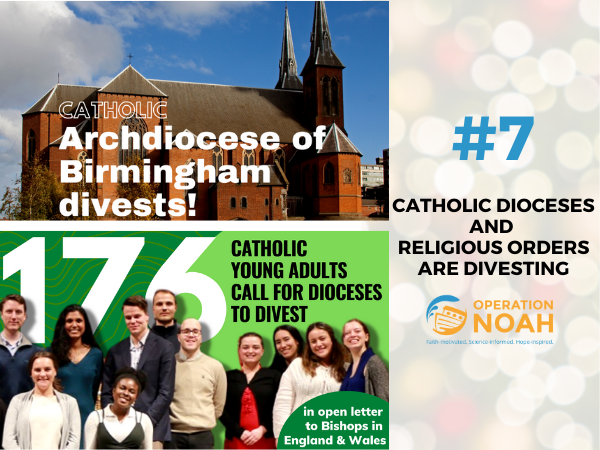
We saw real movement from the Catholic Church this year on divestment, a step recommended by the Vatican. In the Catholic Church of England and Wales, the Archdiocese of Birmingham divested, becoming the first Archdiocese in England and Wales to do so. In September, 176 Catholic young adults from every diocese of England and Wales wrote to bishops calling for divestment from fossil fuels. The week before COP26, the Catholic Bishops’ Conference of Scotland announced its divestment along with more than a dozen Catholic dioceses in the UK and Ireland.

In June, we held a brilliant online Supporters’ Event chaired by one of our trustees, Hannah Malcolm. Over 80 people registered to hear from our speakers, Chine McDonald of Christian Aid, Dave Gregory of the Baptist Union Environmental Network and Josh Tregale of Mock COP26. We also had breakout sessions, providing opportunities for supporters to discuss specific environmental and theological topics.

Operation Noah held a series of divestment webinars in 2021, including a Methodist Webinar in February which featured the founder of the global divestment movement, Bill McKibben. That webinar was watched live by nearly 400 people. In March, we held an Anglican Communion Divestment Webinar with speakers from South Africa, New Zealand, Scotland, Wales and Northern Ireland, with over 200 people watching live.
In late 2021, Operation Noah secured funding to expand our successful Bright Now campaign. This new funding will allow us to hire two new staff members and to scale up our work with UK Churches and faith institutions on investment in climate solutions, such as renewable energy. We will also work with partners on a campaign to encourage the Church of England to increase tree coverage on its land and improve its land management practices, given the urgent climate and biodiversity crises.

Operation Noah welcomes news that Shell pulls out of Cambo oil field, and calls for end to all new fossil fuel developments

Posted in: Blog, Featured
Date posted: 3 December 2021

As an official partner of the Stop Cambo campaign, Operation Noah celebrates the news that Shell has withdrawn from the Cambo oil development, west of Shetland.

Prior to Shell’s announcement, over 70 Church of England clergy and bishops, including Rt Revd Dr Rowan Williams, the former Archbishop of Canterbury, had added their names to an open letter to the Church of England’s Pensions Board, expressing serious concerns about Shell’s plans for the Cambo oil field. The letter stated that the Church of England Pensions Board, which invests in Shell, ‘must make it clear to Shell that swift and resolute action will follow if it does not immediately abandon plans for the Cambo oil field’.

While Shell has concluded that the project is not financially viable, the International Energy Agency (IEA) has said that there can be no new fossil fuel developments if the world is to limit warming to 1.5°C.

The UK Government is now under pressure to officially reject the Cambo oil field. Majority stakeholder in the Cambo oil field, Siccar Point Energy, has expressed its desire to move forward with the project with new backers. If it were to go ahead, the Cambo oil field would produce up to 170 million barrels of oil in the first phase alone, with emissions the equivalent of the annual carbon pollution from 18 coal-fired power stations

According to researchers from Uplift, which is coordinating the Stop Cambo campaign, North Sea oil and gas companies plan to extract at least another 1.7 billion barrels of oil from new fields before 2050. The UK Government is being urged by fossil fuel companies to approve 18 new oil and gas projects over the coming years. Shell is still planning to pursue other new oil and gas projects in UK waters.

James Buchanan, Bright Now Campaign Manager at Operation Noah, said: ‘It is wonderful news that Shell has withdrawn from the Cambo oil field, following pressure from campaigners. Following COP26, Churches need to ensure that the UK Government leads by example and rejects the Cambo oil field once and for all. There can be no new oil, gas or coal developments if we are to limit global average temperature rises to 1.5°C. The world urgently needs a fair and fast transition from fossil fuels to renewable energy, which ensures climate justice and will create green jobs for years to come.’

In May 2021, the Church of England’s Pensions Board voted in favour of Shell’s energy transition plan, which includes increasing gas production by 20% in the next few years and involves plans to seek out new fossil fuel reserves for years to come.

Shell is also under significant pressure to stop seismic drilling off the coast of South Africa. More than 300,000 people have signed a petition calling for an end to the seismic drilling and more than 30 petrol stations are now boycotting Shell. In September, more than 20 Anglican bishops in Southern Africa called for an immediate halt to gas and oil exploration in Africa.

Most UK Churches, including the Central Finance Board of the Methodist Church with £1.3 billion of assets under management, have fully divested from fossil fuel companies. An increasing number of Church of England dioceses are joining them, including the Diocese of Durham, the Diocese of Oxford and the Diocese of Norwich.

Tessa Khan, Director of Uplift, said: ‘This is the end for Cambo. Shell has seen the writing on the wall. Its statement makes it clear that the economics are against new oil and gas developments. But the widespread public and political pressure is what’s made Cambo untenable. This is a message to the UK government that there is no case for new oil and gas. It must put Cambo out of its misery and reject it now.’

Ahead of COP26, 72 Institutions Make Largest-Ever Faith Divestment Announcement

Posted in: Blog, Featured, News

Catholic Bishops’ Conference of Scotland and UK faith groups representing nearly 2,000 local churches announce divestment before UN Climate Conference

Tuesday 26 October 2021: Today, five days before the UN climate conference, COP26, in Glasgow, and four days before the G20 Summit in Rome, 72 faith institutions, including 37 from the UK, announce their divestment from fossil fuels in the largest-ever joint divestment announcement by religious organisations.

The global divestment announcement comes from faith institutions with more than $4.2 billion of combined assets under management in Australia, Ireland, Italy, Kenya, Nepal, Peru, Ukraine, the UK, the United States and Zambia.

Participating institutions include the Catholic Bishops’ Conference of Scotland; the Central Finance Board of the Methodist Church; the Presbyterian Church of Wales; the Presbyterian Church in Ireland; 15 Catholic dioceses in the UK and Ireland, including the Archdioceses of Glasgow, St Andrews & Edinburgh, Birmingham and Southwark; the Church of England Dioceses of Truro and Sodor & Man; and the Buddhist religious movement Soka Gakkai International – UK. The UK Churches and dioceses involved in this announcement represent nearly 2,000 local churches.

It follows the recent call from Pope Francis and other faith leaders to global governments to address the ‘unprecedented ecological crisis’ ahead of COP26 and calls from an international alliance of grassroots multi-faith activists who have called for an immediate end to all fossil fuel finance. Today’s announcement shows an increasing number of Catholic institutions are responding to the recent Vatican recommendation to divest from fossil fuel companies and invest in climate solutions.

Bishop Bill Nolan, Bishop of Galloway and Lead Bishop on the Environment for the Catholic Bishops’ Conference of Scotland, said: ‘The bishops decided that disinvestment would show that the status quo is not acceptable and further, that given the harm that the production and consumption of fossil fuels is causing to the environment and to populations in low income countries, it was not right to profit from investment in these companies. Disinvestment is a sign that justice demands that we must move away from fossil fuels.’

Many UK Churches have fully divested from fossil fuel companies this year, including the Church of Scotland, the Church in Wales and the Baptist Union.

The fossil fuel divestment movement has grown exponentially in recent years. According to a new report published today, more than 1,485 institutions with combined assets of over $39 trillion have made some form of divestment commitment, up from a starting point of $50 billion in 2014. Faith institutions have been at the forefront of the global divestment movement, representing more than 35% of total commitments. Glasgow, Rio de Janeiro, Paris, Seattle and Auckland are also announcing their divestment commitments today, joining the C40 Divest / Invest Forum supporting the advancement of divestment of their city and pension funds. 

The International Energy Agency (IEA) stated in its recent Net Zero by 2050 Roadmap that there can be no new coal, oil and gas developments if the world is to limit global warming to below 1.5°C and prevent catastrophic climate impacts. As world leaders prepare to meet at COP26, the UK Government is coming under increasing pressure over plans for the Cambo oil field off the coast of Scotland, supported by oil giant Shell, which would release emissions equivalent to the annual carbon pollution from 18 coal-fired power stations.

Last month, more than 20 Southern African Anglican bishops including the Archbishop of Cape Town, the three bishops of Mozambique and the Bishop of Namibia called for an immediate halt to gas and oil exploration in Africa. They said that ‘a new era of economic colonialism by fossil fuel companies is well underway’ and that ‘Africa’s natural habitats are being destroyed at an alarming rate through the extraction of oil and gas’.

James Buchanan, Bright Now Campaign Manager at Operation Noah, said: ‘As the UK prepares to host COP26, we are delighted that 37 UK faith institutions have decided to divest from fossil fuel companies and join this record global divestment announcement. We call on the UK and global governments to end fossil fuel subsidies and bring an immediate halt to new oil and gas exploration, including the Cambo oil field.’

A full list of the 72 institutions divesting from fossil fuels and quotes from leaders can be found here.

Statements from leaders:

Archbishop Bernard Longley, Archbishop of Birmingham, said: ‘Our commitment to divestment in fossil fuels is a response both to the cry of the earth and of the poor, taking us one step further towards its consolation. We join many other faith organisations who are making the ethical choice to ‘take care not to support companies that harm human or social ecology… or environmental ecology’, as Pope Francis calls us to do in the Vatican’s manual Journeying Towards Care For Our Common Home. To see so many united in this aim gives me great hope for the future.’

David Palmer, Chief Executive Officer of the Central Finance Board of the Methodist Church, said: ‘The pace of change across the oil and gas sector has been inadequate and falls well below the targets set at COP21 in Paris. We hope that COP26 will refresh these targets and we look forward to joining other faith groups in Glasgow next month in calling for immediate action to address the climate emergency.’

Revd Evan Morgan, Moderator of the Presbyterian Church of Wales, said: ‘Our General Assembly passed a resolution to divest from fossil fuels this year as part of our new green environmental policy as a denomination. We realise time is running out and to safeguard the planet and fulfil our role as stewards of God’s creation, the Church amongst other organisations must act. The time for words, however well meaning, is over and actions now are the order of the day and to be proactive in our response to the challenges of the climate crisis.’

Rt Revd Dr David Bruce, Moderator of the Presbyterian Church in Ireland, said: ‘At its General Assembly on 5 October 2021, the Presbyterian Church in Ireland directed its trustees to employ a new strategy in relation to companies producing fossil fuels or deriving part of their turnover from their use. Specifically this will mean divesting from those companies that derive more than 10% of their turnover from oil and gas extraction and engaging with other companies which are major users of fossil fuels. We believe that our investment policies should be informed by the biblical understanding of creation that leads to a commitment to God’s world and to our global neighbours.’

Robert Harrap, General Director of Soka Gakkai International – UK, said: ‘As a Buddhist organisation based on a philosophy of respect for the dignity of life and the non-duality of the individual and the environment, it is important to us that we invest sustainably and responsibly. Our trustees have decided to divest from fossil fuels because this is a key way to protect our precious planet and the people most at risk from the climate crisis.’

Bishop Luke Pato of Namibia said: ‘We are guardians of the land for the generations to come. Namibia is the driest country south of the Sahara and our ground water is the heritage we leave for our children and grandchildren. We cannot risk drilling operations that pollute precious water sources, abuse indigneous rights and threaten the heritage site of the Okavango Delta.’

Lorna Gold, Chair of Laudato Si’ Movement, said: ‘People of faith are divesting at scale from coal, oil and gas, calling on the G20 in Rome and world leaders at COP26 to finally conclude that there is no future for fossil fuel finance. Fossil fuel divestment is a key part of ensuring a just transition for all, especially communities around the world who have done least to cause the climate crisis.’

Revd Dr Rachel Mash, Environmental Coordinator of Green Anglicans, said: ‘Faced with environmental devastation, pollution of precious water sources and abuse of land rights caused by fossil fuel companies, it is easy for those on the frontline of climate change to feel overwhelmed by the power of these corporations. When we hear that faith communities are taking their money out of these companies, it rekindles hope that we are not alone.’

Revd Fletcher Harper, Executive Director of GreenFaith, said: ‘In the midst of a climate emergency, fossil fuel divestment is a moral imperative. More and more religious groups – Muslim, Hindu, Buddhist and Jewish as well as Christian – must continue to add their names to the growing list of divestment commitments, and must also lead the way by investing in ensuring access to clean energy for absolutely everyone – particularly the 800 million people who lack electricity.’

ENDS

Contact: Cameron Conant, Operation Noah: communications@operationnoah.org

James Buchanan, Operation Noah: james.buchanan@operationnoah.org

Notes for editors:

1. Operation Noah is a Christian charity working with the Church to inspire action on climate change. It works with all Christian denominations. operationnoah.org

2. Operation Noah’s Bright Now campaign encourages UK Churches to divest from fossil fuels and invest in climate solutions. brightnow.org.uk3. The Vatican recommended divestment from fossil fuel companies in June 2020. https://www.reuters.com/article/us-vatican-environment-idUSKBN23P1HI

3. The Vatican recommended divestment from fossil fuel companies in June 2020. https://www.reuters.com/article/us-vatican-environment-idUSKBN23P1HI

4. In September, more than 20 Southern African Anglican bishops called for an immediate halt to gas and oil exploration in Africa. https://www.greenanglicans.org/anglican-bishops-call-for-an-immediate-halt-to-gas-and-oil-exploration-in-africa/

5. The International Energy Agency (IEA) stated in its Net Zero by 2050 Roadmap that there can be no new coal, oil and gas developments if the world is to limit global warming to below 1.5°C. https://www.iea.org/news/pathway-to-critical-and-formidable-goal-of-net-zero-emissions-by-2050-is-narrow-but-brings-huge-benefits

6. The Global Divestment Announcement Statement can be found at the bottom of this blog: https://brightnow.org.uk/news/global-divestment-announcement-divest-your-church-cop26/

Operation Noah Trustee Shilpita Mathews Named Official COP26 Observer

Posted in: Blog, Featured

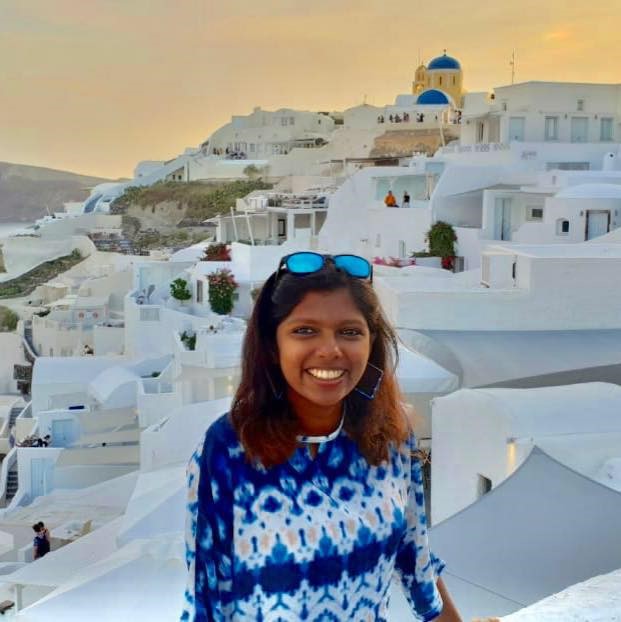
Shilpita Mathews, an Operation Noah trustee, environmental economist and member of Young Christian Climate Network, will produce daily videos from COP26 in Glasgow that we will share via Operation Noah’s social media channels. Here, Shilpita reflects on being an official UN observer at COP26 and what she hopes to achieve.

I will be going to the United Nations’ climate change conference, COP26, in Glasgow. As an official UNFCCC observer (United Nations Framework Convention on Climate Change), I will be in the blue zone of the conference where key negotiations will take place and where delegates from 197 parties and observer NGOs will also be, including observers from Christian NGOs.

This is a chance to make faith-based voices heard at an historic conference that could ultimately determine whether or not we limit global warming to 1.5 degrees, a goal that will require global emissions to be effectively halved by 2030 and for ‘net-zero’ emissions to be achieved by 2050.

Countries will be making important decisions around adaptation and resilience, loss and damage, and climate financing for developing countries. And numerous organisations, such as YCCN, Tearfund and Christian Aid, are calling on leaders to be much more ambitious in their commitments.

What is the Christian Climate Observers Program?

I have been selected as an observer as part of the Christian Climate Observers Program (CCOP). This programme trains the next generation of climate leaders from a Christian and missional perspective. CCOP is organised by a consortium of organisations, such as the Lausanne Network and A Rocha. At the conference itself, I will be representing the World Evangelical Alliance.

My goals for COP26

Ensuring social and racial justice is at the heart of climate action

I will use this opportunity to call on UK Christian leaders to link climate action with racial and social justice. Most importantly, I want to diversify the conversation on climate justice by calling youth from minority communities to make connections globally and to take climate action locally.

As a trustee for Operation Noah and a member of the Young Christian Climate Network, I am eager to build on the momentum of COP26 as Christian NGOs respond to the call for climate justice. Following CCOP, I hope to speak at churches, write about my experiences for Christian charities and use my learnings from CCOP to drive climate action amongst Christians.

In the words of John Stott, former rector of my home church in London:

It seems quite inexplicable to me that there are some Christians who claim to love and worship God, to be disciples of Jesus, and yet have no concern for the earth that bears his stamp of ownership. They do not care about the abuse of the earth, and indeed, by their wasteful and over-consumptive lifestyles, they contribute to it.”

Bringing faith leaders and the private sector together

As someone working in the private sector as an economist, I believe that we can work #TogetherForOurPlanet. Business and industry play a key role in financing climate solutions, with private finance accounting for the majority of climate finance in 2018-2019.  Similarly, faith groups represent 80% of the world’s population and play a powerful role in advocating for change, as demonstrated in the leadership of Pope Francis. COP26 is an opportunity to build bridges at a time of crisis.

Business and industry are at the forefront of climate risks, as we found in the Third UK Climate Change Risk Assessment, of which I was a contributing author. Similarly, a majority of Christians today live in developing countries, and represent the communities most vulnerable to climate change. I want to understand synergies between the two groups to help enhance climate resilience.

How can you support me

COP26 is bound to be a rewarding but overwhelming experience and I would appreciate your prayers, support and encouragement.

You can follow my COP26 journey in three ways:

CCOP21 newsletter: Please fill out this form to receive daily prayer newsletters from COP26 by the CCOP21 team.

60-second Twitter reflections: While at COP26, I will be posting a 60-second reflection every day. You can follow me on Twitter (@ShilpitaMathews) or via the @OperationNoah handle.

Join ongoing events: There are many ways to support COP26 events in Glasgow, but I would specifically like to invite you to join Young Christian Climate Network in celebrating our 4 month-long Relay to COP26. Join us online or in-person as we give thanks and look ahead.

Thank you!

Finally, thank you for your incredible support in helping me reach 125% of my crowdfunding target to attend COP26! I am so thankful for your generosity and for your encouragement in this journey. 

Shilpita Mathews holds degrees from Cambridge University and the London School of Economics. She is an environmental economist and was a co-author of the Third UK Climate Change Risk Assessment.

Supporters’ Event Recording

Posted in: Featured
Date posted: 1 July 2021

Listen back to the amazing speakers from our recent Supporters’ Event.:

  • Chine McDonald from Christian Aid on racial and climate justice
  • Rev Dr Dave Gregory from Baptist Union Environmental Network and the John Ray Initiative on divesting from fossil fuels
  • Josh Tregale of MOCKCOP26 on youth climate activism

Operation Noah in 2020

Posted in: Featured, Reports

Operation Noah’s annual Director’s Report for 2020 is available to download.

Our annual accounts for 2020 can be viewed here.

Find out more about what we got up to in 2020.

If you have any questions about our Director’s Report or annual accounts, please contact: admin@operationnoah.org.

Registered charity number 1138101