T 07804 059426 E admin@operationnoah.org


When world leaders decided to postpone UN climate talks for a year due to the pandemic, young people, recognising the urgency of the climate crisis, decided not only to hold their own, online conference but also to see if they could improve on the original plans. Josh Tregale reports.

Between the 19th November and 1st December over 330 youth delegates representing over 140 countries took part in Mock COP26. An online youth led event filling the void left by postponement of COP26. I have had the privilege of working as an Event Coordinator for Mock COP26 since September. We had speeches from high profile public figures including the COP26 President, UN Youth Envoy, UN Special Rapporteur on human rights and the environment, the High-Level Climate Action Champion for UN climate talks, scientist, economists and youth activists. All of the content from Mock COP26 can be viewed online on our YouTube channel www.youtube.com/c/mockcop26.
The conference mirrored some of the processes of COP summits although some changes were made to increase inclusivity and accessibility. Mock COP26 had a particular focus on the Global South who are on the front line of the climate crisis yet contribute the least to cause the problem. 72% of our delegates were from these countries and their votes were weighted above those from the Global North. Like with COPs the event ended in a global statement, declaring what actions and policies the youth delegates would commit to if they were the political leaders. The statement can be read at www.mockcop.org/treaty and it includes 18 policies ranging from climate education to the protection of indigenous land rights, Nationally Determined Contributions and Physical and Mental health.
I am so pleased with how the conference went, we had an estimated media reach of 98 million people and 5.4 million impressions of the #MockCOP26 hashtag on Twitter alone. The next challenge of Mock COP26 is to campaign for world leaders to listen to our ambition and push for more action ahead of COP26. It is crucial that as Christians we engage in policy, we are called to be ‘wise stewards of the earth’ and it is the rules and commitments of countries that have the most impact on stewarding the earth.
Please pray that world leaders listen to what young activists are calling for and that they raise their ambition ahead of COP26. The recovery from the pandemic has the potential to leave a lasting legacy and signal a new phase in our commitment to the preservation of our God’s creation and those who live in it.

This week marks the fifth anniversary of the Paris Climate Agreement. Shilpita Mathews and Josh Evans consider our progress, and lack of, in implementing the agreement.

‘Humanity is waging war on nature. This is suicidal. Nature always strikes back and it is already doing so with growing force and fury,’ were the remarks of UN Secretary General, António Guterres, in a speech entitled State of the Planet, last week. This is a sombre tone as the world marks the fifth anniversary of the Paris Climate Agreement on the 12th of December. As we look forward to the UK hosting the COP26 conference in Glasgow in November 2021, there is a need for urgent climate action.
We are not on track to meet the global 1.5°C target
Despite the progress made, there is an ambition-implementation gap when it comes to emission reductions. Global commitments, fall short of meeting 1.5°C, with Climate Action Tracker (CAT) calculating that in a best-case scenario, net zero pledges could lead to warming of 2.1°C by 2100. However, they also show that this estimate has dropped from 3.5 degrees in 2009 with 0.5 degrees of this in the last year alone as a direct result of climate emergency and net-zero declarations.
Further commitments are required by governments
While the UK has committed to reducing emissions by 68% by 2030, this remains below the 70% reduction required to meet Paris targets projected by Sir Nicholas Stern, the author of the landmark Stern Review on the economics of climate change. Moreover, the UK’s current Covid recovery stimulus spending is behind other European countries when it comes to a just and green recovery.
Concerningly, there remains a stark contrast between government spending on programmes like ‘Gear Change’, promoting cycling and walking ( £2 billion), and continued spending on road building (£27 billion) as well as £12.8 billion on fossil fuels annually. This indicates ambitious 2030 targets are needed to prevent catastrophic consequences, as the UK announces its Nationally Determined Contributions (NDCs) this week.
Delaying action will impact the poorest countries the most
Meeting Paris commitments in a cost-optimal way will require a global reduction in emissions by 40%–50% by 2030. Research show that delayed action will lead to additional costs and may lead to the failure of the Paris Agreement as a whole. These costs will be borne disproportionately by developing countries. For instance, South-East Asia will face more extreme impacts than other regions, with 600 million to one billion people in Asia living in areas with a nonzero annual probability of lethal heat waves by 2050.
Rich countries have an obligation under the Paris agreement to provide $100 billion a year to help developing countries limit pollution and adapt to climate change. However, recent UK aid budget cuts, from 0.7% to 0.5% of gross national income, jeopardise this.
Divestment makes economic sense
Net zero targets outline a hopeful trajectory for planet earth and a worrying message for anyone deeply invested in fossil fuels. Stranded assets could become a reality faster than anyone has previously predicted. There are economic gains to be made as entire economies orient themselves to net-zero pathways. Yet, the Transition Pathway Initiative (TPI), a project launched by the Church of England and supported by several Churches, found in its 2020 State of Transition Report that none of the major oil companies are aligned with the Paris Agreement targets.
The climate crisis demands urgent action
We are at the crossroads of climate action. In the lead up to COP26, there are many ways citizens and churches can hold the government accountable:
From plans outlined in the USA by the incoming Biden-Harris administration, to China’s recent climate targets, there is much to be hopeful for. Yet, as Guterres reiterated, ‘the targets set at Paris were always meant to be increased over time.’ The world needs urgent action if we are to address the climate emergency. As we look ahead from Paris, the UK needs to make the most of its impressive diplomatic networks to orchestrate a similar united approach in 2021.
Shilpita Mathews is currently Strategy Lead at YCCN and serves in the student ministry of her home church, All Souls Langham Place in London.
Josh Evans was part of the Pilgrimage2Paris in 2015 and is currently Campaigns Lead at YCCN.
Operation Noah board member, Nicky Bull, writes a short review of every book she reads. Here she shares her reviews of a number of books she has read in the last two years which we think will be of interest to Operation Noah supporters.

Falter: Has the human game begun to play itself out? (Bill McKibben)
This is a fairly terrifying book as it tells it like it is with regard to the effect that we are having on the climate of our planet. What I wasn’t expecting was the inclusion of a section detailing what McKibben sees as the other major threat to the ‘human game’: the further development and implementation of artificial intelligence (AI). None of this makes for comfortable reading and yet there is an underlying hope that seeps through – a belief in the ability of humanity to make sufficient changes and turn things around if only we can keep alive a vision of what it really means to be human. The rapid growth in the use of sustainable and renewable energy, and the rousing of public opinion displayed in non-violent direct action are the two threads that give the author some optimism in what would otherwise be a bleak future.
No One is Too Small to Make a Difference (Greta Thunberg)

This slim volume, an easy read in a single sitting, contains the texts of Greta’s addresses given in the course of less than a year to some of the most powerful people in the world, as well as to mass gatherings of concerned citizens. This diminutive Swedish schoolgirl goes straight to the heart of the climate crisis and to the flawed economic systems that are reacting too little and too slowly in addressing the damage that we in the privileged and wealthy countries of the global north are inflicting on the planet that supports all life. She is saying what we should have been saying for decades.
Losing Earth: The Decade We Could Have Stopped Climate Change (Nathaniel Rich)
I have no reason to doubt the details in this book, charting the progress or otherwise of climate change awareness and action between 1979 and 1989 in the USA – and I suspect that there were similar scenarios being played out to at least some extent in other countries across the developed world, where we are all so dependent upon energy from fossil fuels. It is a salutary tale, and in many ways a deeply depressing read, but a really important one. However, the Afterword is crucial and does contain some tiny germs of hope, with its recognition that despite all the corporate lobbying, the activities of environmentalists, and the politics, this global existential problem is actually an issue of morality and of recognising our responsibility to our fellow human beings – and to those yet to be born. That the younger generation are doing much better at this is at least some cause for hope.
Say No to Plastic: 101 Easy Ways to Use Less Plastic (Harriet Dyer)
A really handy little guide that would be especially useful for anyone just beginning to look at how to reduce their use of plastic in response to concerns about the chemicals and particles it produces when degrading. It is now well known that these contaminate our oceans and that there is a huge volume of waste plastic being shipped across the globe where it potentially has even more damaging effects than it would in our own landfill sites. Only a small proportion is effectively recycled and we urgently need to reduce our use by finding, or reverting to, good sustainable alternatives. There are a few rather outlandish ideas – to make up the count? – but on the whole this little book contains sensible and practical advice.
On Fire (Naomi Klein)
In her most recent book Klein uses lectures and addresses that she has given since 2010 to chart the climate crisis and to reinforce her case that what is needed is a Green New Deal. Her arguments are very persuasive and I only briefly lost sympathy when she criticised Nathaniel Rich’s Losing Earth for its analysis that a major problem in tackling climate change is ‘human nature’. Klein prefers to see big corporations and governments as the problem – and she is not wrong to do so – but they are run by people and while their greed, power-hunger and desire to dominate are hugely problematical they are surely aspects of human nature, and perhaps an exaggeration of traits that many of us possess? However, both authors agree that part of what is needed is to recognise the ‘villains’ and to take action if climate catastrophe is to be averted.
Time To Act (Christian Climate Action)

This is a really good little book and would be a particularly good read for anyone who is unsure about exactly what Extinction Rebellion and their faith-based members stand for, and why they do what they do. But for someone who has followed XR’s story, both in the media and talking to friends who are involved, there was nevertheless a lot here that was new and interesting. The book is a compilation of contributions from a range of different people – some are sympathetic onlookers, some seasoned activists and a few are among the ‘arrestables’; these are testimonies of concern, compassion and hope and I highly recommend their stories.
The Case for the Green New Deal (Ann Pettifor)
I confess that much of the detail of this book went over my head – I can scarcely begin to understand the intricacies of high-level economics or global finance. However, the central message – which I heard direct from Pettifor at a talk last year – is that system change is possible and is absolutely necessary if the world is going to succeed in tackling climate change. As the book’s title suggests, Pettifor makes the case for the Green New Deal as being proposed in both the UK and the USA and there are a number of places in the text – written, of course, before this year’s pandemic began – where what she says comes across as prophetic.
The Future We Choose: Surviving the climate crisis (Christiana Figueres and Tom Rivett-Carnac)

I think this is a really important book. Co-authored by the former Executive Secretary of the UN Framework Convention on Climate Change, who was the driving force behind the Paris Agreement, it is in almost equal measure terrifying and hopeful. With a clear description of the probable consequences if we fail to reach net zero global carbon emissions by 2050, balanced by the possible scenario if we can succeed in reaching that goal, this book should surely be read by everyone in positions of influence and power in the world. The prospects are not great at present but the authors nevertheless champion optimism and action as the way forward – and they reiterate the message of Greta Thunberg and others, that everyone can make a difference.
Climate Chaos and the Global Green New Deal (Noam Chomsky and Robert Pollin)
I have read a number of things about proposed ‘green deals’ but this book was the first to make it absolutely clear how vital it is that plans to tackle the climate crisis are global in scope and not restricted to the current major emitting nations. It is a relatively short book, and presented in a question-and-answer, conversational format that is accessible and not at all heavy going, despite the complicated issues discussed. The two extremely distinguished authors bring differing perspectives and are talking out of the US context but the overall conclusion is very plain, and urgent. While the prospects for global cooperation on anything might not have looked great a year ago, the Covid-19 pandemic has provided some degree of optimism: it is all too easy to see how a failure to act, on the part of any nation, leaves the whole world vulnerable.
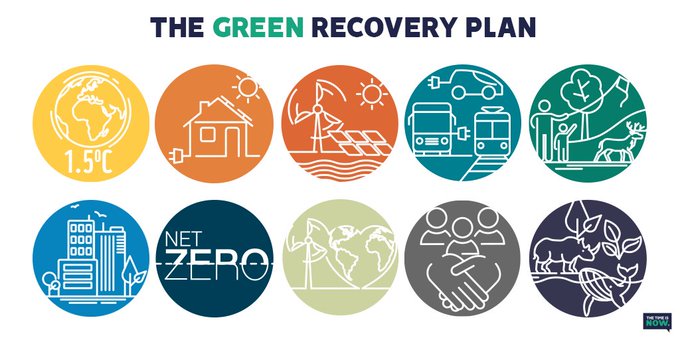
Operation Noah is one of 70 organisations who have, today, launched a 10 -point plan designed to get the UK on track to net-zero emissions whilst also showing global leadership ahead of hosting the United National climate summit, also known as COP26, this time next year.
Last month the Prime Minister confirmed that the government will take action to achieve 40GW of offshore wind by 2030, more than enough to power every home in the UK. This was set out as the first point of a 10-point plan for a ‘green industrial revolution’. The full plan will be laid out before the end of this year. In the meantime, a number of NGOs working on climate change has set out our own 10-Point Plan.
The ten points include the UK taking on its fair share of effort to keep global temperatures rises to 1.5°C above pre-industrial levels, investing in domestic energy efficiency and heat pumps which will help us move away from using gas to heat homes, fully decarbonising our power system and ambitious targets for nature restoration. All ten points are set out in this document.
The time to act is now
Actions taken now by governments to respond to the current health crisis and rebuild our economy will have an impact for generations to come. Decisions taken today will determine whether we succeed in our goal to protect the people, places and life we love from the climate crisis. We can limit global temperature rise to 1.5°C, halt and reverse the decline of nature and eradicate poverty, or we can lock in pollution and inequality for generations.
Next year the eyes of the world will be on the UK as it hosts the UN Climate Summit, COP26. This is an opportunity to deliver a strong global lead on climate action. The best way to show this leadership is to put resilience at the heart of our economic recovery by accelerating the transition to net-zero, restoring nature and supporting the most vulnerable at home and overseas.
The 10-point plan is part of the Climate Coalition’s campaign for the government to deliver an economic recovery that sets us on a path to a cleaner, greener world that works for everyone.
Posted in:
Articles
Date posted: 7 October 2020
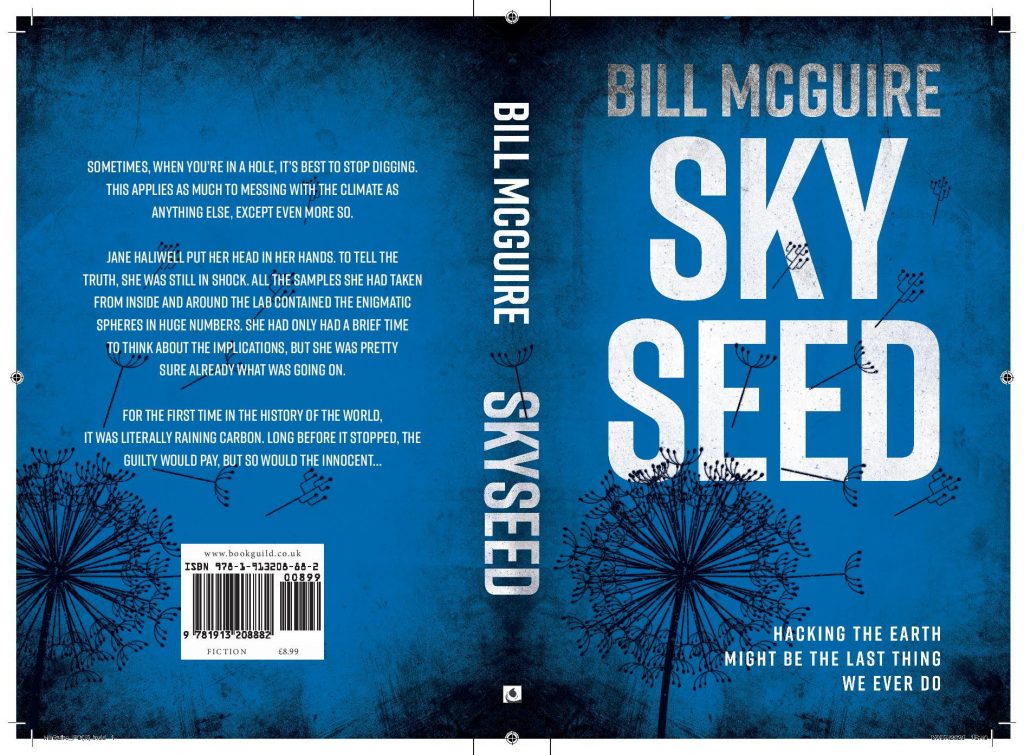
Bill McGuire, Professor Emeritus of Geophysical & Climate Hazards at UCL and a regular guest blogger for Operation Noah, has just published his eco-thriller, Skyseed. It explores what could go wrong if we use climate engineering to try to solve the climate crisis.
It beggars belief that as the climate crisis deepens, calls to try technological tinkering to get us out of the mess grow ever louder. Remember, we are where we are, because we have been conducting an experiment with the composition of our planet’s atmosphere ever since the wheels of the industrial revolution began to turn. Launching another experiment to try and solve the problems brought about by the first is exactly what we don’t need. But that is what the supporters of so-called geoengineering –intentional, large-scale, interference with the environment – want to do.
In the footsteps of Dr. Strangelove
The belief that we can apply a techno-fix to stop global heating in its tracks has been around for quite a while. None other than Edward Teller – father of the H-bomb and putative inspiration for Dr. Strangelove – was keen on the idea. Wild and wacky as ever, Teller toyed with such notions as giant sunshades in space, or deluging the stratosphere with billions of tiny reflective spheres, to block out part of the sun’s heat. Today’s schemes are perhaps less freaky, but no less risky for that. Broadly-speaking, they can be grouped into plans – like Teller’s – for reducing the sun’s input (Solar Radiation Management), for easing the passage of heat from the Earth into space (Earth Radiation Management), and for sucking carbon dioxide from the air (Carbon Dioxide Removal).
Mimicking a volcano
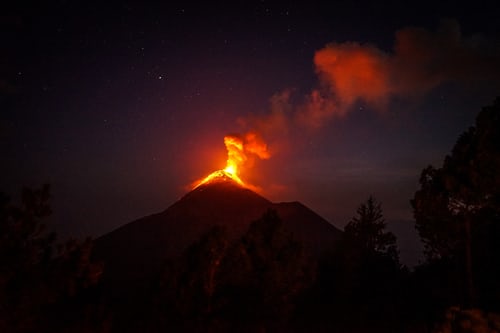
Amongst the many geoengineering schemes proposed to put global heating in its place, one seems to have gained significant support in the last couple of years. Following in Teller’s footsteps, the plan is to mimic a large volcanic eruption by pumping millions of tonnes of sulphur dioxide into the stratosphere. As happens after a major volcanic blast, the gas would form an aerosol veil of tiny sulphuric acid droplets, conjuring up a planetary shroud to manage incoming solar radiation. In fact, the tiny droplets are especially effective at reflecting the sun’s heat back into space, so cooling the troposphere (the lower atmosphere) and the surface beneath. This is why a significant fall in global temperature follows very large volcanic eruptions.
Global cooling
In the years immediately after the 1991 eruption of Pinatubo (Philippines), the global average temperature fell by around 0.6°. Looking back further, the 1783 Laki (Iceland) outburst caused severe cooling across Europe and North America the following year, and even weakened the African and Asian monsoons. Most famous of all, the colossal 1815 blast of Tambora (Indonesia) is held responsible for the so-called ‘Year Without a Summer’ in 1816, which drove widespread harvest failure, famine, and the last, great, subsistence crisis in the western world.
Wishful thinking
But geoengineers are nothing if not optimists, which is why they poo-poo the mass of evidence for the manifold and unpredictable ways in which stratospheric sulphur veils can affect the climate system and, ultimately, society and economy. In fact, some insist that their modelling shows that everyone will be a winner. Generating and maintaining an artificial volcanic shroud, they say, will have positive benefits for all. A significant reduction in global temperatures without any nasty side effects. This touching confidence in technology has always smelled to me of a conspiracy of scientistic hubris and a particularly naïve confidence in modelling. Others say it is just pie-in-the-sky.
What could possibly go wrong
There are so many potential problems associated with such attempts to artificially block the sun’s input that it is difficult to know where to start. Studies have shown that plant photosynthesis would slow, resulting in falling crop yields. Solar power installations would become less efficient, while the sulphur gases could damage the ozone layer. Regional rainfall patterns could bring drought to some places and floods to others.
Tackling the symptoms, not the cause
At the same time, the oceans would keep on getting more acidic, as the scheme does nothing to reduce atmospheric carbon levels. And this is the nub of the problem. By seeking to reduce temperatures while doing nothing about carbon emissions, nor carbon dioxide levels in the atmosphere, such a solar radiation management techno-fix simply addresses (one of) the symptoms of global heating and accompanying climate breakdown, not the cause.
What we need are urgent measures to slash carbon emissions at a rate that is in line with keeping the global average temperature rise (compared to pre-industrial times) below the 1.5° dangerous climate change guardrail. What we don’t need are harebrained techie schemes that are costly, dangerous, and detract from efforts to tackle global heating by conventional means. Such dubious plans should stay where they are most at home, in the pages of a science fiction book.
Skyseed is here
Speaking of which, if you want to find out what happens when a climate engineering programme goes pear-shaped, you could do worse than read my just-published eco-thriller, Skyseed. Hacking the Earth could be the last thing we ever do.
Bill McGuire is Professor Emeritus of Geophysical & Climate Hazards at UCL and author of Waking the Giant: How a Changing Climate Triggers Earthquakes, Tsunamis and Volcanic Eruptions. He was a contributor to the IPCC 2012 report on Climate Change & Extreme Events and Disasters.

Churches up and down the country have been running Climate Sunday services since the initiative launched in September. Operation Noah trustee, David Miller, explains how his church put on an online service.
The opportunity to help our church – currently in the middle of an interregnum – by proposing a preacher and sermon subject for Sept 6th was too good to miss! Our church, Whaddon Way Church, is an ecumenical church in Bletchley, an established town in the south-west of Milton Keynes.
So it was that the Revd Steve Barnes, retired chaplain of our local hospice, preached at our Zoom service on Climate Sunday. Steve cares passionately about the environment and for many years he and I have worked together as participants in our local Green Christian group.
Steve proposed that, in a similar way that cells reproducing in an uncontrolled way (cancer) have a catastrophic effect on our bodies, humanity’s ever-growing consumption of resources and generation of pollution including greenhouse gases, are destroying the natural world created by God and for which we are supposed to be exercising care and protection. Particularly in the rich west, we have allowed ourselves to become addicted to the pursuit of having more, better, newer, faster, and no longer recognise when enough is enough.
Whereas any member of the human race should be concerned about the way their present actions may be compromising the future for our children and grandchildren, Steve argued that for Christians this represents a spiritual problem. Referring to the old testament passage we had read (Ezekiel 33:7-11) Steve explained that we need to become modern-day prophets, warning of the wrong path being travelled and the consequences for the world God has created. Failure to do so will result in God holding us responsible.
Jesus came to give us life in all its fulness and to bring joy, peace and love. When we pray Thy Kingdom Come, Thy Will be done on earth, we are effectively saying to God that we desire a world which is in keeping with how He intends it to be. He wants us to be participants in that project!
After the Zoom service, Steve moved around several of the breakout rooms and discovered many folks enthusiastic about exploring what actions they could take to address the environmental challenges that face us. The trustees have agreed to set up a working group tasked with proposing a way forward for the church. At the time of writing, the first volunteers have already come forward…..
Climate Sunday, an initiative proposed by Operation Noah and organised by Churches Together in Britain and Ireland’s Environmental Issues Network, with support almost 20 organisations, is asking churches to hold a climate-focused service between now and 5th September 2021, to make a commitment to take long term action to reduce their own greenhouse gas emissions and to use their voice to tell politicians we want a cleaner, greener, fairer future at the heart of plans to rebuild a strong economy. Find out more.
